


Think grind size or tamp pressure are the main reasons for thin, patchy crema?
Blame distribution first.
When grounds settle unevenly, water finds weak spots and rushes through, producing pale crema and mixed over- and under-extraction.
This post shows how distribution sets puck resistance, how that resistance shapes crema and extraction balance, and the single first change to test at your bench.
You’ll get quick checks and one clear move to make shots thicker, more even, and more repeatable.
How Distribution Influences Crema Formation and Extraction Balance
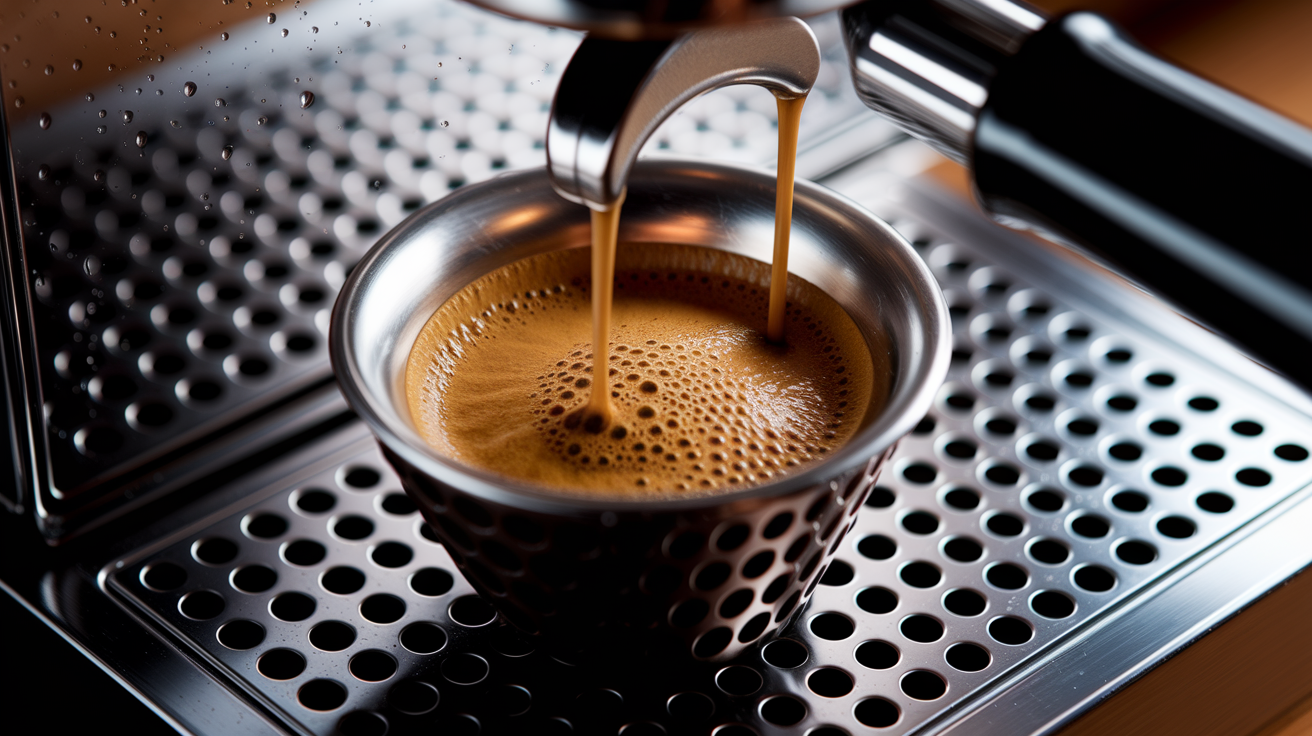
When coffee grounds settle unevenly in the portafilter basket, they create invisible density gradients that completely change how water moves through the puck. Distribution controls resistance within the coffee bed, and resistance dictates where water flows, how fast it goes, and how thoroughly it extracts soluble material and oils. Crema forms when pressurized water dissolves CO2 and emulsifies oils, then releases them as microbubbles at the spout. If distribution’s inconsistent, water takes shortcuts through soft spots and low-resistance zones, bypassing denser regions entirely. Those shortcuts produce thin, pale crema because the liquid never had enough contact time to extract oils and gas properly.
Even distribution creates uniform hydraulic resistance across the entire puck surface. When resistance is balanced, water spreads evenly, contacts every particle for the same duration, and extracts at the same rate from top to bottom. This uniform extraction maximizes oil emulsification and CO2 release, producing thick, chestnut-brown crema with fine microbubbles and a smooth texture. The crema stays stable for several minutes because the oils form a consistent foam structure. When distribution fails, the puck develops weak zones where water accelerates through, pulling sour acids and under-extracted flavors, plus tight zones where water stalls, over-extracting bitter compounds. The result is mottled crema with light patches from under-extracted streams and dark patches from over-extracted zones, often collapsing within seconds.
Distribution also controls how the puck blooms during pre-infusion. A well-distributed bed absorbs water evenly, swelling uniformly and maintaining structural integrity as pressure builds. Poor distribution causes localized blooming, where wet zones expand while dry pockets remain compressed, fracturing the puck and opening channels before full pressure hits. Once a channel forms, it self-reinforces. Water follows the established path, enlarging the gap and further reducing extraction in surrounding areas. The crema from a channeled shot looks broken, with visible streams of different colors, inconsistent thickness, and rapid separation. Fixing distribution means controlling density from the moment grounds enter the basket, long before the tamp.
Common Distribution Problems and Their Impact on Extraction
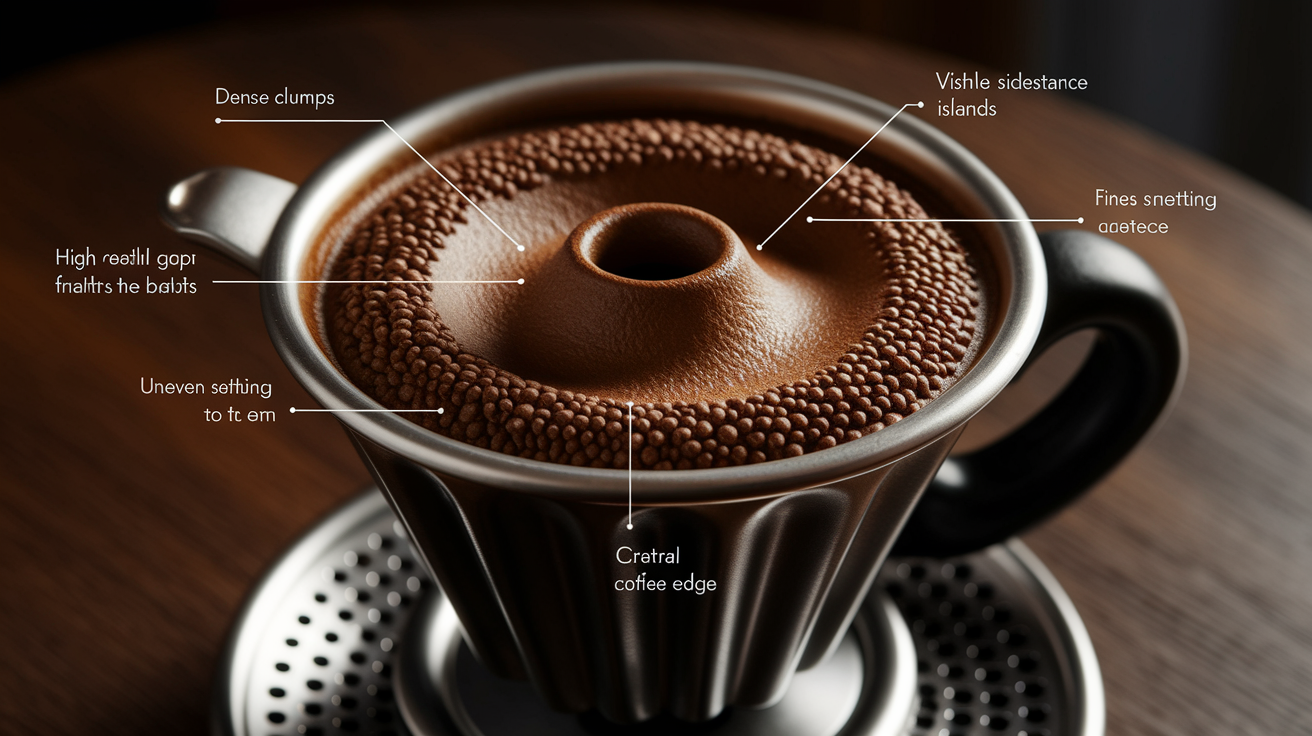
Clumping is the most frequent distribution fault. Freshly ground coffee carries static charge and moisture, causing particles to stick together in dense clusters. When clumps sit in the basket, they form high-resistance islands that force water to detour around them, creating flow imbalances and thin crema in under-extracted zones. Tamping can’t break clumps because it only compresses the top surface. The internal structure remains uneven, and water exploits every weak point the moment pressure rises.
Side-wall gaps appear when grounds settle away from the basket perimeter, leaving a visible or invisible air space along the edge. Water rushes down these gaps at high speed, bypassing the puck entirely and producing fast, watery shots with almost no crema. Even a 1 mm gap can divert enough flow to ruin extraction balance.
Clumping: Dense particle clusters block flow locally, forcing water through surrounding soft zones and creating sour, under-extracted streams with pale crema.
Side-wall gaps: Air pockets along the basket rim allow water to bypass the puck, shortening contact time and yielding thin, watery espresso with minimal foam.
Uneven settling: Grounds pile higher on one side of the basket, creating a slope that shifts hydraulic pressure and produces uneven wetting, irregular flow, and patchy crema.
Fines migration: Fine particles settle to the bottom during dosing, forming a dense layer that chokes flow and over-extracts, darkening crema and adding bitterness.
Volcano effect: A divot or crater in the center of the dose traps air and creates a weak zone where water jets through, causing early blonding and unstable crema.
Overfilled or underfilled baskets: Incorrect dose height changes headspace and compression ratio, altering flow resistance unpredictably and destabilizing extraction curves.
Each of these faults disrupts the pressure equilibrium that espresso machines rely on. Water seeks the path of least resistance, and any density inconsistency becomes a preferential flow channel. Once flow concentrates in a channel, local velocity increases, extraction time shortens, and the liquid exits pale and acidic. Meanwhile, bypassed zones sit nearly dry, contributing nothing to crema or flavor. The visible result is broken, tiger-striped foam that separates into light and dark bands, signaling simultaneous under-extraction and over-extraction within the same shot.
Mechanics of Extraction and How Water Interacts with the Coffee Bed
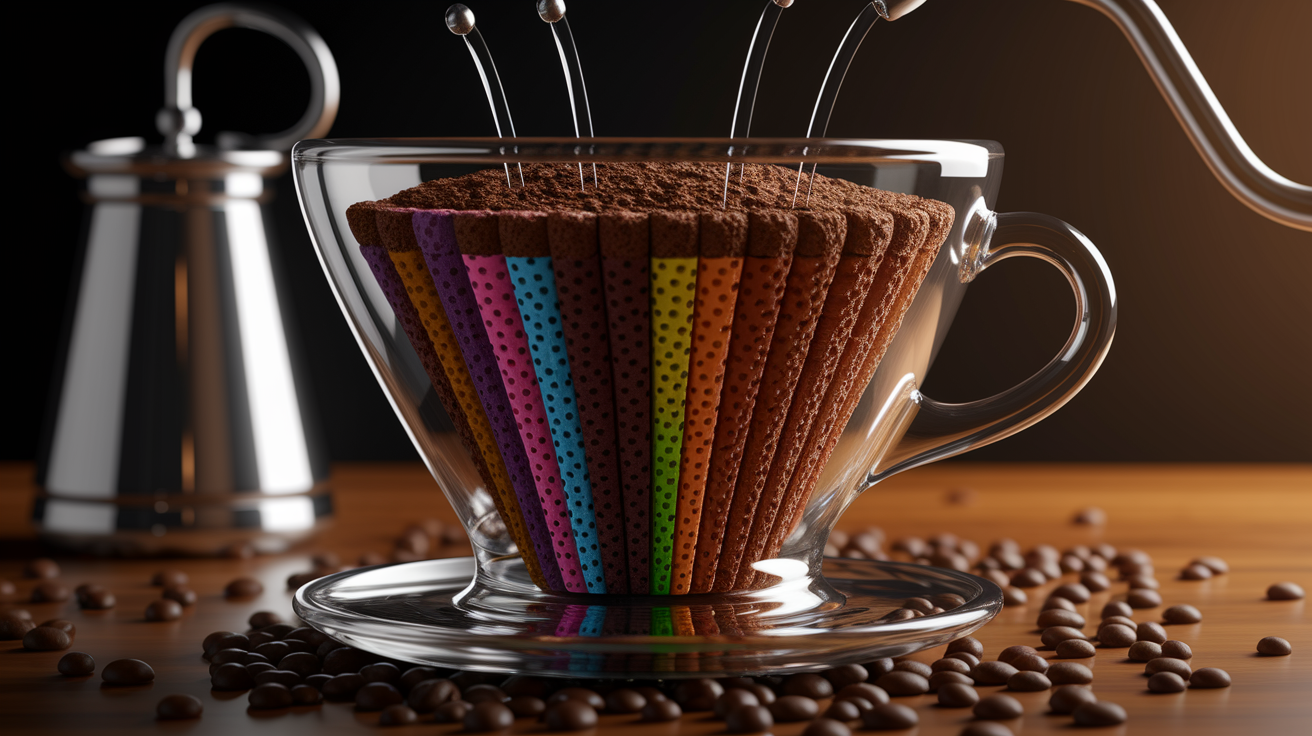
Espresso extraction operates under constant pressure, typically around 9 bars, forcing water through a compressed bed of ground coffee. At the particle level, water dissolves soluble compounds (sugars, acids, oils, and gases) through diffusion and convection. The rate of extraction depends on contact time, temperature, and surface area exposed to water. When the puck has uniform density, water velocity remains consistent across the entire cross-section, and every particle experiences the same extraction environment. This uniformity increases the total dissolved solids, stabilizes pH, and maximizes oil emulsification, producing rich, stable crema with balanced flavor.
Micro-level density differences within the puck create turbulent flow patterns that shift extraction curves unpredictably. In a tightly packed region, water slows down, increasing contact time and solubility. Extraction yields rise, pulling more oils and bitter compounds, and the resulting liquid is darker, heavier, and more astringent. In a loosely packed region, water accelerates, reducing contact time and under-extracting. The liquid emerges pale, sour, and lacking body, with minimal oil content and almost no crema contribution. Because these two conditions happen simultaneously in a poorly distributed puck, the final shot tastes unbalanced. Neither sweet nor clean, with crema that looks broken and collapses quickly.
Oil emulsification is especially sensitive to pressure stability. Espresso oils are hydrophobic and require mechanical energy to disperse into water as micelles and microbubbles. Steady pressure provides that energy, breaking oil droplets into sub-100-micron bubbles that remain suspended in the liquid, forming crema. When flow channels through weak zones, pressure drops locally, emulsification fails, and oils either pass through unemulsified or remain trapped in the puck. The crema loses thickness and stability, often separating into a thin layer of large bubbles that pop within seconds. Good distribution keeps pressure uniform across the puck, sustaining emulsification throughout the entire extraction window and producing the dense, velvety foam that defines quality espresso.
Visual and Sensory Indicators of Good vs. Poor Distribution
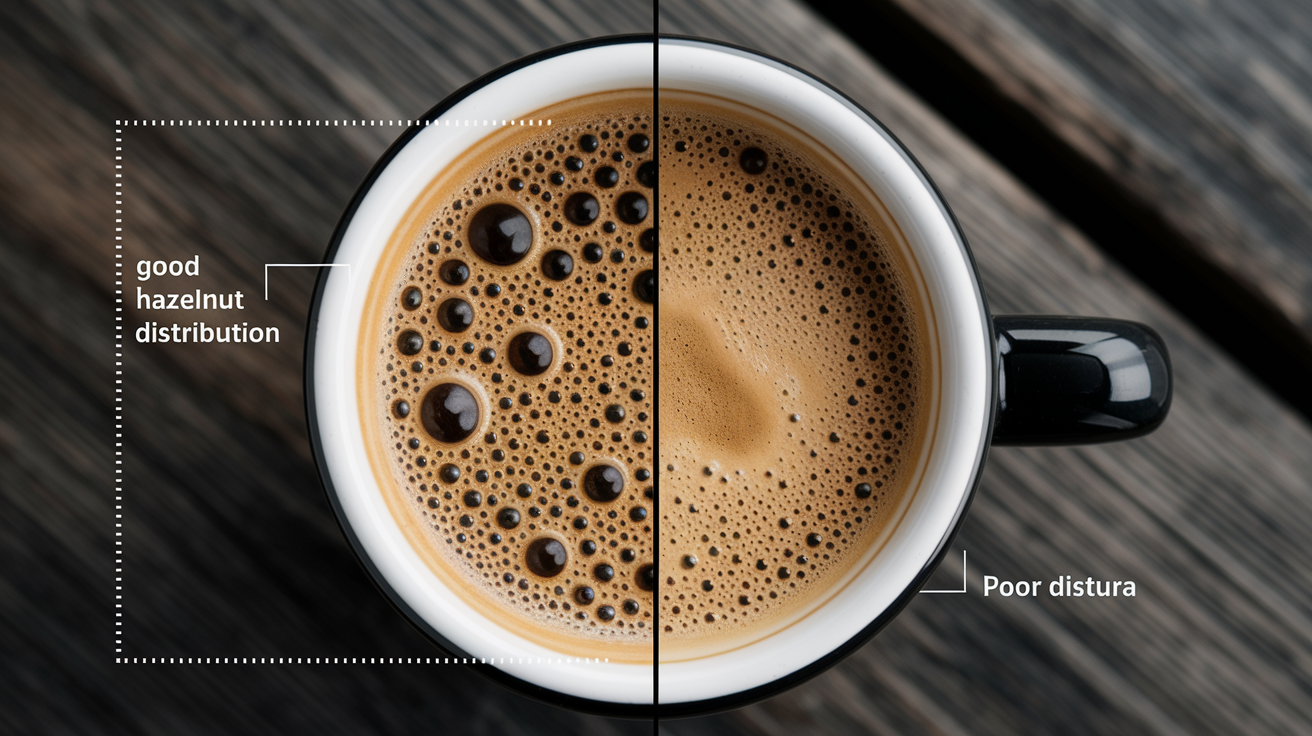
A properly distributed puck produces a smooth, honey-like stream from the portafilter spout, flowing steadily without spurts or spray. The crema builds gradually, starting deep reddish-brown and lightening to hazelnut as the shot progresses. The foam is thick, dense, and uniform in color, with a fine microbubble texture that resists collapse. There’s no early blonding, no visible jets, and no separation into light and dark zones. The puck after extraction looks evenly saturated, with a consistent texture and no tunnels or dry patches.
Poor distribution shows up immediately as uneven flow patterns. You might see multiple thin streams from different points on the spout, or a single fast jet accompanied by slow drips elsewhere. The crema forms in patches, with light sections indicating under-extraction and dark sections suggesting over-extraction. Tiger-striping, where light and dark bands alternate across the surface, is a classic sign of channeling caused by uneven density. The foam collapses quickly, often within 30 seconds, leaving a flat, separated surface with large bubbles and visible liquid underneath.
| Indicator | What It Suggests |
|---|---|
| Smooth, steady honey-like stream | Even distribution, uniform flow resistance, balanced extraction |
| Multiple thin jets or spray pattern | Channeling from clumps, side-wall gaps, or uneven settling |
| Deep hazelnut crema with fine microbubbles | Good oil emulsification, stable pressure, optimal extraction |
| Mottled crema with light and dark patches | Simultaneous under- and over-extraction from uneven density |
| Crema collapses in under 1 minute | Low oil content, poor emulsification, channeling, or stale beans |
| Dry channels or tunnels in spent puck | Water bypassed those zones; distribution or grind fault |
Techniques for Improving Distribution Consistency

Improving distribution means controlling particle arrangement before any pressure hits the puck. The goal is to eliminate clumps, fill voids, level the bed, and create uniform density from edge to edge so water has no weak zones to exploit.
Weiss Distribution Technique (WDT): Use a thin needle or multi-needle tool to stir the grounds gently in the basket. Start with 10 to 20 passes in a cross-hatch pattern, reaching all the way to the bottom. This breaks up clumps, redistributes fines, and fills air pockets. WDT is the single most effective step for reducing channeling.
Tapping to settle: After dosing, tap the side of the portafilter 3 to 6 times with short, controlled strikes. This settles loose grounds into voids and removes trapped air without over-compacting. Tapping works best after WDT, not as a replacement.
Vertical settling: Hold the portafilter level and tap it vertically on the counter once or twice. This encourages even settling across the entire surface, especially in the center where grounds often pile higher after grinding.
Finger-leveling: Run your finger gently across the top of the dose to knock down high spots and push grounds into low areas. This creates a flat surface before using a distribution tool or tamping. Keep the motion light to avoid compacting one side more than the other.
Distribution tool (palm leveler): Place the tool flat on the grounds and rotate 2 to 3 times, applying gentle downward pressure. The tool’s fins or ridges move grounds laterally, filling gaps and smoothing the surface. Adjust the tool depth to match your dose so it levels without compressing too early.
Once you’ve got a flat, clump-free bed, tamp with consistent pressure and zero lateral movement to lock the structure in place. Distribution and tamping are separate steps with different jobs. Distribution arranges particles evenly. Tamping compresses them uniformly. Skipping or rushing distribution means the tamp will only compress an already uneven bed, locking in the faults. A reliable workflow always includes WDT first, then settling, then leveling, then tamping. When those steps happen in sequence, water spreads evenly, extraction balances, and crema forms thick, stable, and uniform every time.
We started by showing why even distribution matters: it sets puck resistance, steadies pressure, and helps oils emulsify into a richer crema.
Then we walked through common faults, the extraction mechanics, visual and sensory cues to watch, and practical steps—WDT, tapping, settling, and leveling—to make puck prep repeatable.
Keep changes small and measure grams and time. This shows exactly how distribution affects crema and extraction balance, so you get steadier shots and more satisfying crema in just a few tries.
FAQ
Q: What are the three factors that can affect the extraction time?
A: The three factors that can affect extraction time are grind size, dose and puck prep (distribution and tamp), and water temperature and pressure, which together set flow rate and contact time.
Q: What is the 15-15-15 rule for coffee?
A: The 15-15-15 rule for coffee is a simple brew start: 15 grams coffee, add 15 grams water to bloom, then wait 15 seconds before continuing the pour to stabilize extraction.
Q: What is the 80 20 rule for coffee?
A: The 80 20 rule for coffee means most improvement comes from a few basics: prioritize fresh beans, consistent grind, correct dose, and solid technique over expensive gear.
Q: What is the purpose of distributing coffee grounds evenly in the portafilter?
A: The purpose of distributing coffee grounds evenly in the portafilter is to create uniform resistance, prevent channeling, ensure even extraction, and improve crema volume, color, and stability.