
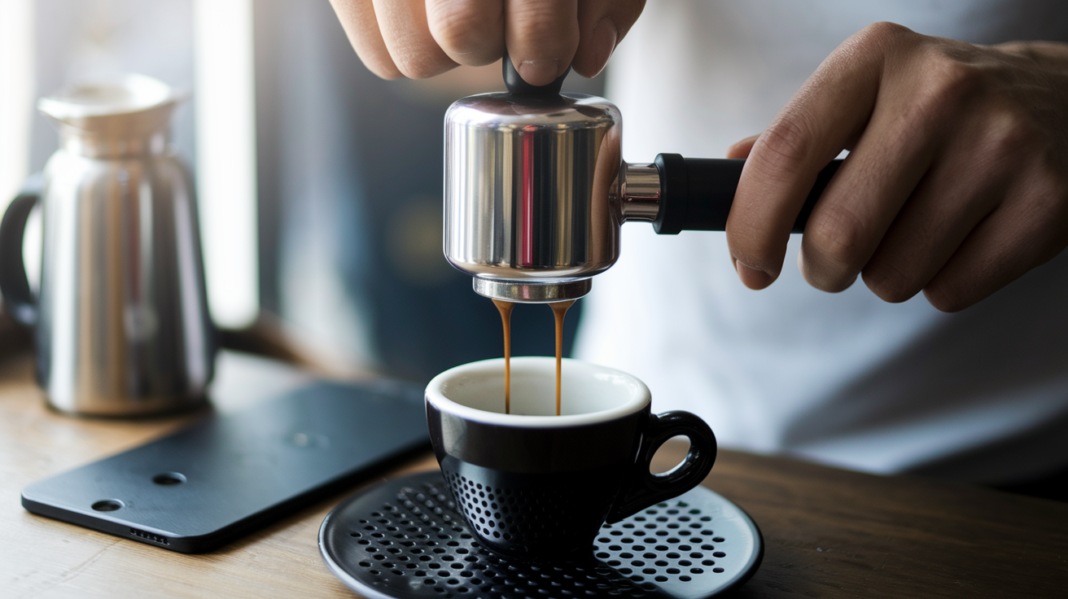

Think tamper weight is just for show?
It actually changes how the puck compacts and how steady your shots are.
Heavier tampers add passive force and resist tiny tilts, so you reach your target pressure more often without extra arm work.
But research shows that once a puck is already compacted, extra tamp force rarely moves extraction numbers.
The real benefit of weight is repeatability: fewer edge channels, steadier flow, and less shot-to-shot scatter.
In short, tamper mass helps consistency more than it changes chemistry.
Core Mechanisms Behind Tamper Weight and Espresso Puck Compaction
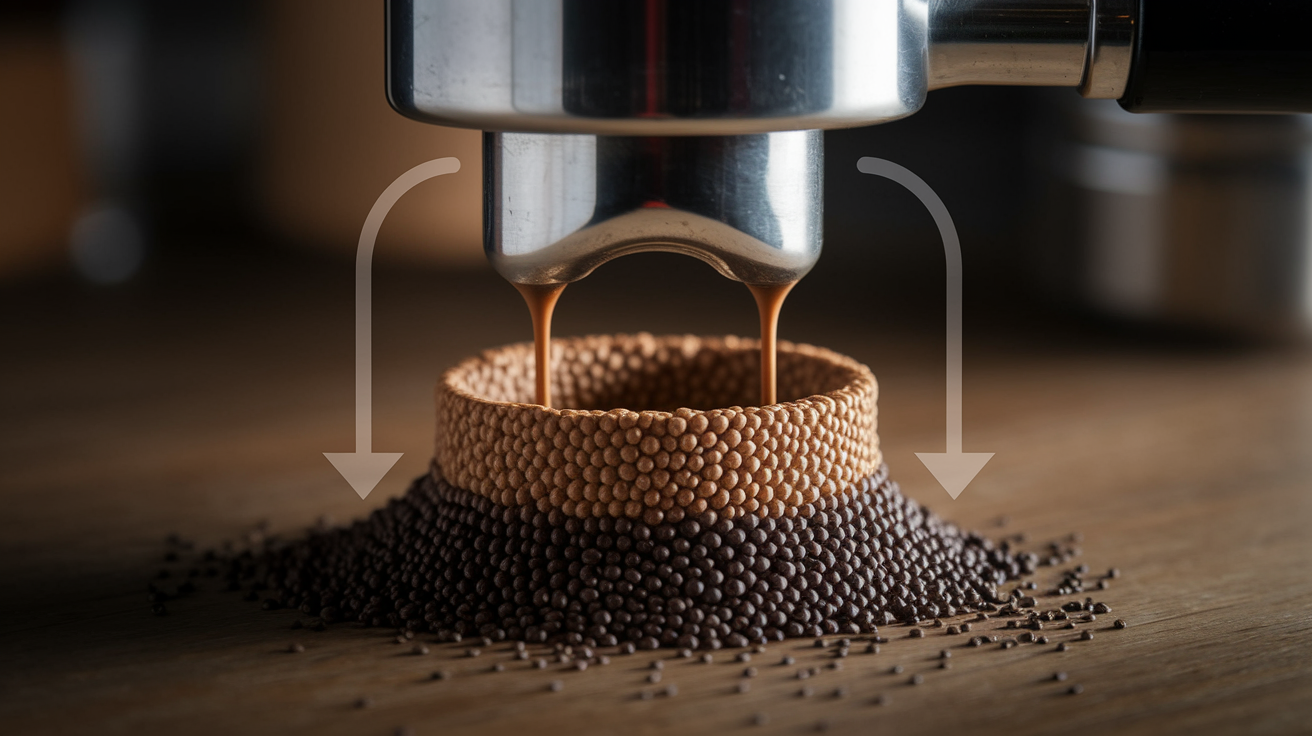
Tamper weight is basically force sitting in your basket before you even push. When you press, the total force you’re applying comes from two things: the tamper’s mass pulling down through gravity, plus whatever your arm adds. A heavier tamper does more work just by existing. A 700-gram tamper resting in the basket gives you about 1.5 pounds before you touch it. A 300-gram tamper? Maybe 0.7 pounds. That gap means the heavier one delivers a few extra pounds for free, so you don’t have to push as hard to hit that 30-pound target everyone talks about.
Static compaction is the final settled density after you press. It depends on total force, not the tamper’s weight alone. Once you push, coffee particles shuffle into tighter packing until friction and interlock stop them from moving any further. Tests using 5 kg to 20 kg of tamp pressure (roughly 12 to 42 pounds) found no real differences in total dissolved solids or extraction yield when dose, grind, water pressure, and temp stayed the same. The study showed brew weight was the only thing that actually predicted TDS, not how hard you pressed. In that 20-gram dose trial with a 58-millimeter tamper, the puck hit effective compaction somewhere in the lower range, and piling on more force past 30 or 40 pounds didn’t do much.
Dynamic compression happens during the shot when pump pressure (usually 9 bar) squeezes the puck down like a spring. A well-tamped puck holds its shape and fights off micro-channels, keeping water flowing evenly across the whole bed. Tamper weight helps this happen indirectly. Heavier tampers tend to drop straighter into the basket and cut down on tilted pressing that leaves thin spots at one edge. Once you’ve hit basic compaction, adding more weight or force won’t change how the puck manages flow because the grounds are already locked into their tightest stable arrangement.
Key mechanisms linking tamper mass to puck performance:
Coffee beds max out their density around 30 pounds. Past that, extra force barely compresses anything. A heavier tamper wobbles less during the press, which means fewer uneven spots and less channeling. Puck resistance controls flow rate, but how you distribute grounds before tamping matters way more than tamper mass. Extra weight keeps the base flat and damps small side-to-side movements, which helps seal the basket perimeter evenly. Above roughly 40 pounds of total force, you’re in diminishing returns territory. The structure’s already set, so extra tamper mass does nothing for extraction numbers.
Comparing Light vs Heavy Tampers and Their Influence on Puck Density
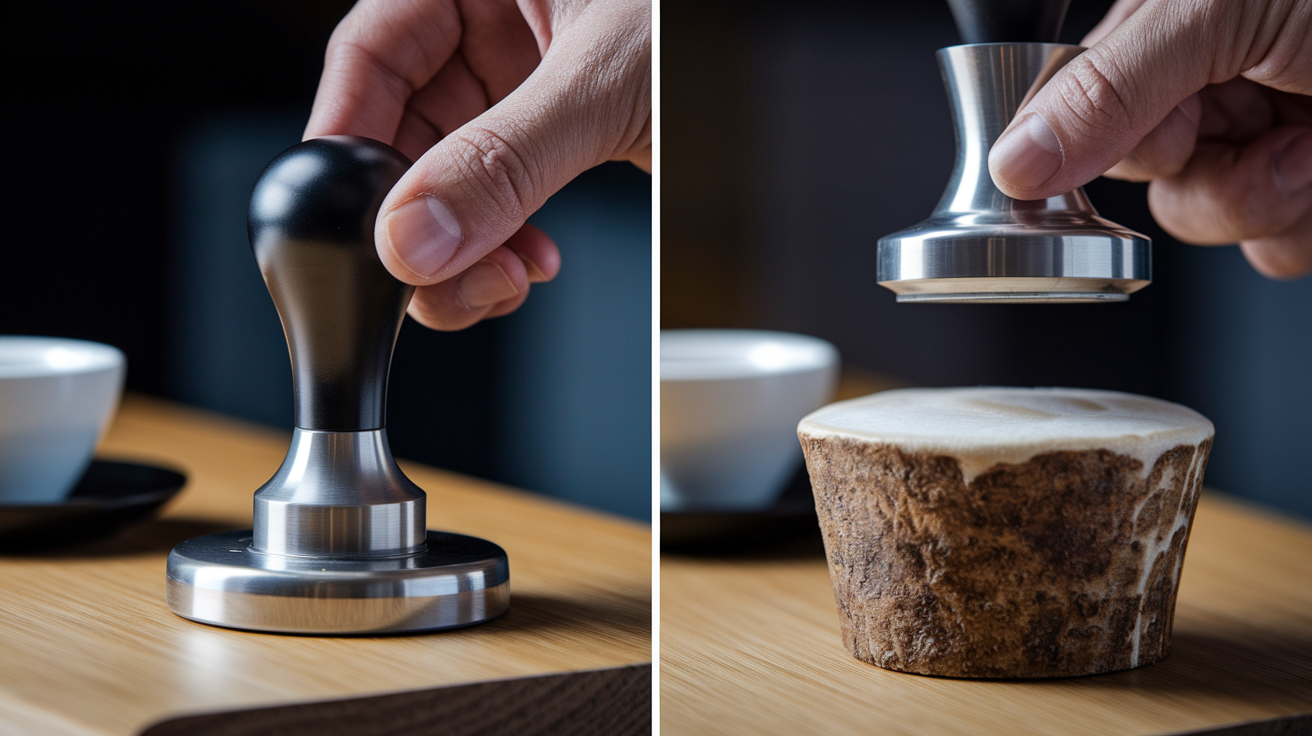
Light tampers (200 to 350 grams) need more deliberate pushing to hit target compaction. They don’t bring much gravitational force to the table, so any wobble in your arm pressure shows up as variable puck density. Beginners with a light tamper often under-tamp some shots and over-correct on others, creating all kinds of scatter in shot timing. A heavy tamper (500 to 800 grams) delivers several extra pounds passively, shrinking the range of arm strength you need to hit that 30-pound sweet spot. That passive mass helps repeatability, especially during long café shifts when your arm starts to tire.
Inertia matters too. A heavier tamper resists tiny changes in wrist angle. When you tilt a light tamper even a little, the small mass lets that tilt carry into the puck, leaving one side thinner. A heavy tamper’s inertia fights off those small shifts, keeping the base more level while you press. This leveling stability cuts down on edge channeling, those fast streams that pop up when water finds the thinnest escape route along the basket wall. That said, no experimental data connects tamper mass directly to extraction yield within the 5 to 20 kg force range that’s been tested. The real benefit of a heavy tamper shows up as tighter shot-to-shot consistency in flow rate and brew time, not as a bump in average extraction.
| Tamper Type | Typical Mass | Expected Effect on Puck Density |
|---|---|---|
| Light (entry-level) | 200–350 g | Requires more conscious arm force; higher variability in compaction; lower passive resistance to tilt |
| Medium (standard café) | 400–550 g | Moderate passive force; good balance of user control and stability; suitable for most workflows |
| Heavy (precision/competition) | 600–800+ g | Highest passive force and inertial stability; minimal arm-push variability; best repeatability but may cause fatigue over many shots |
A medium tamper sits in the sweet spot. It offers enough passive force to reduce variability without the ergonomic load that heavy tampers impose when you’re pulling shots for hours. The table shows that puck density outcomes are less about absolute mass and more about how the tool’s weight plays with your ability to apply repeatable, level force. Distribution quality still runs the show. No tamper weight can fix clumps or voids left in the coffee bed before you press.
How Tamper Weight Interacts With Flow Rate, Channeling Risk, and Extraction Balance
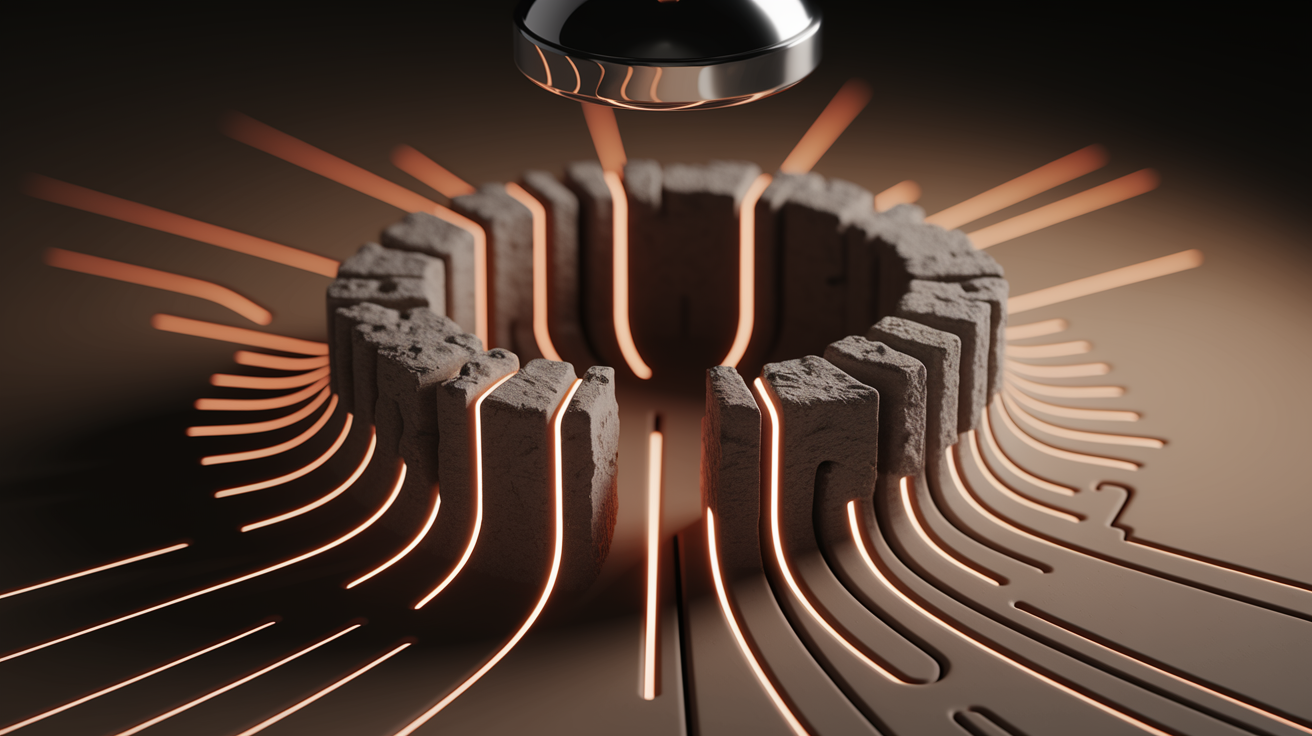
Flow rate through the puck comes down to permeability, which depends on particle size, puck thickness, and local density variations way more than tamper mass. Water takes the path of least resistance, so even a tiny 0.25-millimeter gap between the tamper base and basket wall creates a fast channel around the edge. Experimental data showed that tamping pressure had no real effect on time to reach target beverage weight (p = 0.30). Shots hit 40 grams of liquid in statistically identical times across the 5 to 20 kilogram tamp-force range. Brew weight was the only variable that reliably predicted total dissolved solids.
Channeling shows up when water finds weak spots: clumps that didn’t break up, air pockets from uneven settling, or edges where the puck wasn’t sealed. A heavier tamper cuts down on one specific failure mode—tilted tamping—by resisting small wrist movements that leave one side under-compacted. But if distribution was sloppy before tamping, even a perfectly level heavy tamp will press uneven density into the puck, and the shot will channel anyway. Trials using deep Weiss Distribution Technique shrank peak puck-resistance variability from a 40 percent spread to a much tighter range and wiped out almost all the fastest gushers. That shows pre-tamp distribution quality matters way more for flow stability than tamper weight. Adding a dry paper filter on top of the puck bumped measured resistance by about 7 percent but didn’t stop central hollows in spent pucks when initial distribution left the center less dense.
Extraction balance is about getting sugars, acids, and bitters into the cup at the right mix. That depends on contact time and even flow across the bed. A heavier tamper doesn’t directly change contact time or what dissolves chemically. It just slightly improves the odds that flow will be uniform. When flow is uneven, some coffee over-extracts (bitter, harsh) and some under-extracts (sour, thin), and the cup tastes muddled. Fixing that imbalance means fixing distribution and grind uniformity first, then applying a consistent tamp (light or heavy) to lock the bed into a repeatable starting point.
Common causes of channeling and how tamper weight does (or doesn’t) help:
Clumps in the dry bed? Tamper weight does nothing. You need to break clumps with pre-tamp stirring or a distribution tool. Air pockets from uneven settling? Tamper mass helps a little by applying more passive downward force, but tapping the portafilter sides before tamping works way better. Tilted tamp leaving one edge thin? Heavier tampers resist tilt better because of inertia, so this failure mode drops. Poor tamper-to-basket fit with a gap bigger than 0.25 mm? Tamper weight is irrelevant. Only a precision-sized base prevents edge channeling. Grind too coarse or dose too low? No tamper mass will fix insufficient particle surface area or not enough bed depth to create resistance. Incomplete saturation at start of extraction? Tamper weight has zero effect on saturation. Adding a short pause after preinfusion is the fix.
Physics of Force Application: Tamper Mass vs Muscle Force and Inertial Stability

Applied force during tamping is the sum of gravity pulling the tamper down and the active push from your arm. A 600-gram tamper contributes roughly 1.3 pounds just sitting in the basket. The remaining 28 to 29 pounds to hit a 30-pound target? That’s all you. A lighter 300-gram tamper gives you only about 0.7 pounds, so you’re supplying nearly the full 30 pounds through arm strength. That difference shows up when you’re tired or dialing in shots quickly. Heavier tampers make it easier to stay near the target without tracking how hard you’re pressing on every single pull.
Inertial stability is about a tamper’s resistance to small lateral or angular shifts during the press. When the base is coming down, any sideways wobble or tilt creates uneven compaction. A heavier tamper has higher rotational inertia, meaning it takes more torque to knock it off vertical. In real terms, if your wrist drifts slightly to one side, a 700-gram tamper will fight that drift better than a 250-gram tool, keeping the base flatter and the final puck more uniform. This stability effect is most obvious when baristas tamp standing up or when the portafilter is held at an awkward angle. The extra mass acts like a gyroscopic damper, smoothing out micro-adjustments that would otherwise leave density gradients across the puck.
Practical Methods to Gauge Applied Force
The easiest calibration tool is a bathroom scale. Put the portafilter (or a flat block of similar height) on the scale and zero it. Hold the tamper like you would during a real tamp, press straight down, and watch the display climb to your target. Thirty pounds is the baseline most people aim for. Repeat this ten to twenty times until your arm learns what 30 pounds feels like. Experimental setups have used force-sensing devices like the Smart Tamp, which verified applied pressure to within a tight tolerance. Researchers noted that standardized tamping got rid of one major source of shot-to-shot scatter and confirmed that extraction differences came from other variables, not inconsistent pressing.
Another option is a calibrated spring-loaded force tamper. These tools click or lock at a preset force, giving you instant tactile feedback when you’ve hit the target. They take out guesswork but don’t teach your arm what 30 pounds feels like if you switch back to a standard tamper later. For baristas pulling high shot volumes, practicing on a scale at the start of each shift or once a week keeps muscle memory sharp, especially since a heavier tamper’s passive contribution might shift your learned “push feel” compared to a lighter model you used before.
Experimental Evidence on Tamping Pressure (5–20 kg) and What It Implies for Tamper Weight
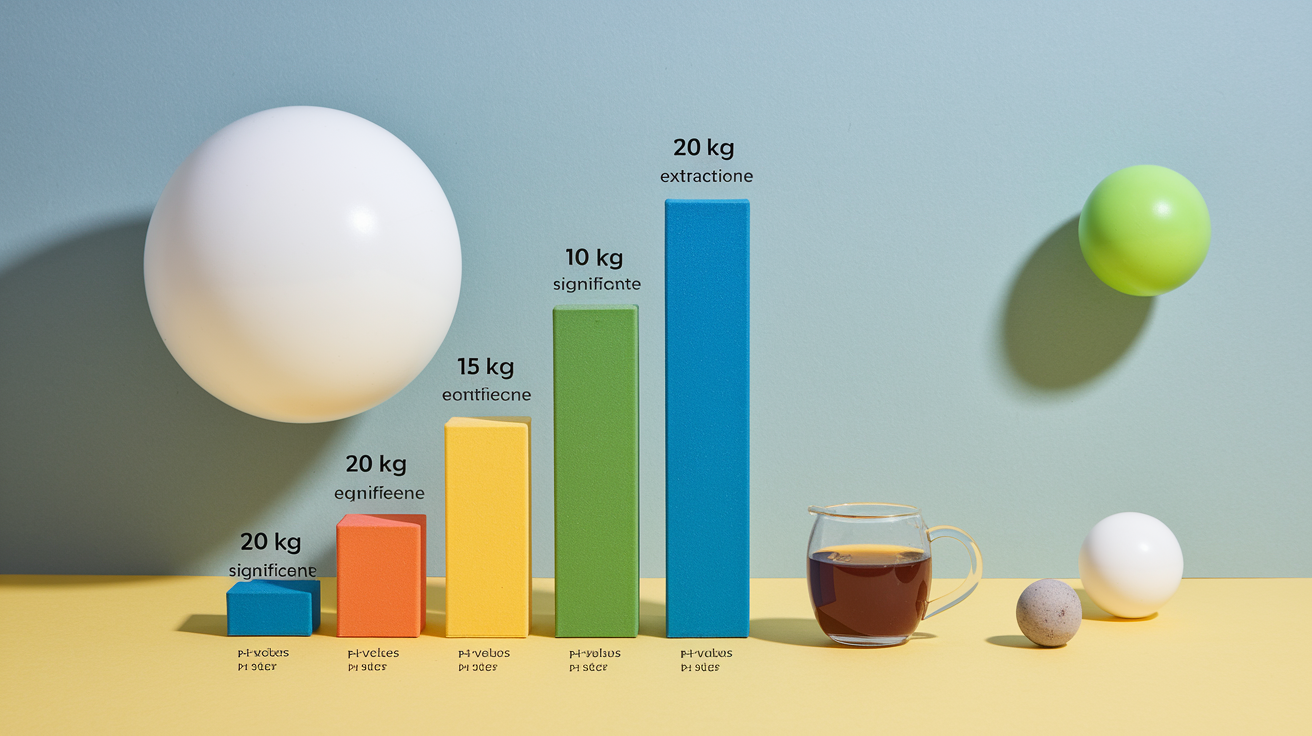
A controlled study tested four tamping pressures: 5, 10, 15, and 20 kilograms (about 12, 22, 32, and 42 pounds). They pulled 40 shots per refractometer device, using a single batch of coffee rested 11 days, a 20-gram dose pulled to 40 grams final beverage weight, and a fixed grind setting dialed to produce roughly 40 seconds brew time at the 15-kilogram baseline. Statistical analysis (ANOVA) showed no significant difference in total dissolved solids or extraction yield across the tested tamp pressures (p = 0.40), and there was no interaction between device type and tamping force (p = 0.70). The only variable that significantly predicted TDS was final brew weight (p = 0.00), which explained about 18 percent of measured variance in a four-level regression model.
These results mean that once a tamper (no matter its mass) delivers enough force to get the puck past its compaction threshold—somewhere below the 5-kilogram mark in this trial—adding more force or using a heavier tamper to reach higher pressures doesn’t measurably change how much coffee dissolves into the water. The puck’s ability to resist flow and support even extraction depends way more on grind size, dose accuracy, and how evenly the grounds were distributed before tamping than on whether the final press was 12 pounds or 42 pounds. In practice, this means a lighter tamper that consistently hits 25 pounds will produce statistically identical extraction to a heavy tamper that consistently hits 35 pounds, as long as both fall within the effective compaction range and both are applied level.
| Tamping Pressure Tested | Mean TDS Observed | Mean Extraction Yield Trend |
|---|---|---|
| 5 kg (≈12 lb) | No significant difference vs other pressures | Within normal variance; effective compaction achieved |
| 10 kg (≈22 lb) | No significant difference vs other pressures | Within normal variance; effective compaction achieved |
| 15 kg (≈32 lb) | No significant difference vs other pressures | Within normal variance; effective compaction achieved |
| 20 kg (≈42 lb) | No significant difference vs other pressures | Within normal variance; diminishing-returns zone |
The table shows that across the full tested range, TDS and extraction yield stayed statistically flat. For tamper weight, the takeaway is clear: a heavier tamper won’t unlock higher extraction or better flavor just because it’s heavy. Its value is in helping you apply repeatable, level force with less conscious effort, which shrinks shot-to-shot scatter in brew time and flow rate even if average extraction stays the same. If you already tamp consistently with a light tamper, switching to a heavy one won’t change your average cup quality. But if you struggle with repeatability, the added inertial stability and passive force of a heavier tool can tighten your workflow.
Interaction of Grind Size, Distribution, and Tamper Weight in Puck Compaction
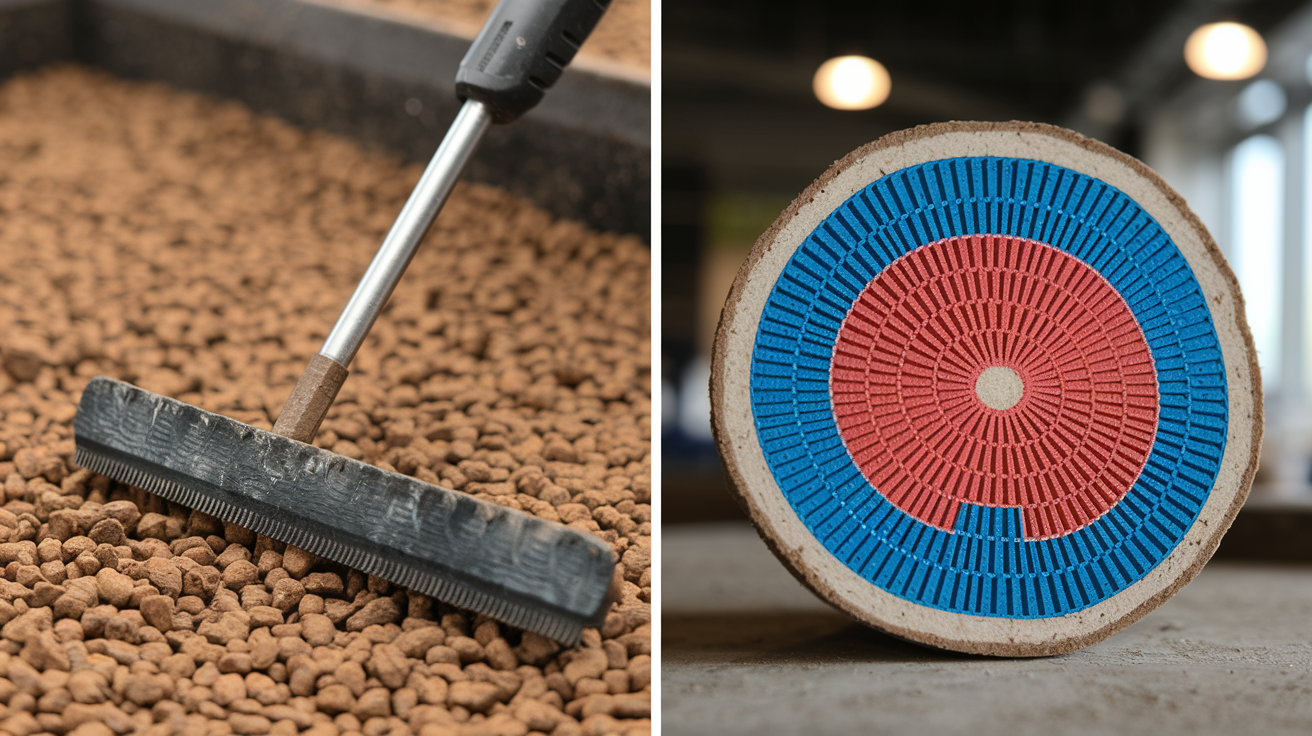
Grind size sets the baseline permeability of the coffee bed by determining particle surface area and the size of gaps between grounds. A finer grind creates smaller voids, higher flow resistance, and longer contact time. A coarser grind does the opposite. Tamper weight can’t compensate for the wrong grind setting. If the grind is too coarse and the shot gushes in 15 seconds, pressing harder with a heavier tamper will compress the bed a little but won’t create enough extra resistance to slow the shot to 30 seconds. You’ve got to grind finer. If the grind is too fine and the shot chokes, using a lighter tamper won’t open up enough flow. You’ve got to grind coarser.
Distribution quality—how evenly the dry coffee is spread in the basket before tamping—dominates final puck uniformity more than any other single variable. Experimental trials using deep Weiss Distribution Technique (stirring the grounds thoroughly from top to bottom with a fine needle tool) shrank peak puck-resistance variability to a narrow range and eliminated most of the extreme fast gushers that showed up with surface-only distribution. Surface distribution alone left about 40 percent spread in peak resistance, meaning some shots had very low resistance (fast flow, under-extraction) and others had high resistance (slow flow, risk of over-extraction or choking). End-of-shot resistance variability was much smaller, only about 5 percent, comparable to the effect of changing dose by 1 gram on an 18-gram pull. But the early-shot chaos from poor distribution can’t be fixed by tamping harder or switching to a heavier tamper.
Visual inspection of spent pucks revealed central hollows in shots where the coffee was loaded as a mound and distributed only at the surface. Even adding a dry paper filter on top (which bumped measured puck resistance by roughly 7 percent) didn’t prevent these central voids. Grinding directly into the basket in a circular motion and then doing deep distribution reduced the hollows, showing that how grounds land in the basket, how they’re stirred, and how they’re finally compressed determines puck geometry. Tamper weight adds stability to the final press but can’t rearrange particles that were already clumped or unevenly settled.
Best practices for synergy between distribution and tamper weight:
Always distribute before tamping. Use a WDT tool to stir the entire bed from bottom to top, breaking all clumps and leveling the surface. Tap the portafilter gently on the counter or with your palm to settle loose grounds and release trapped air pockets before the tamp. This step cuts down on how much you’re relying on tamper mass to force out voids. Choose a tamper that fits the basket within 0.25 mm. Precision fit matters more than weight. Even a heavy tamper will leave a perimeter channel if the base is undersized. Keep dose consistent to within 0.1 grams. Small dose shifts change bed depth and resistance more than reasonable changes in tamper mass. Adjust grind size, not tamp force, to dial shot time. Once you’ve got a repeatable tamp (light or heavy), use grind adjustments to hit your 25 to 30 second target and preserve the relationship between contact time and extraction balance.
Practical Recommendations for Choosing Tamper Weight for Home and Café Routines
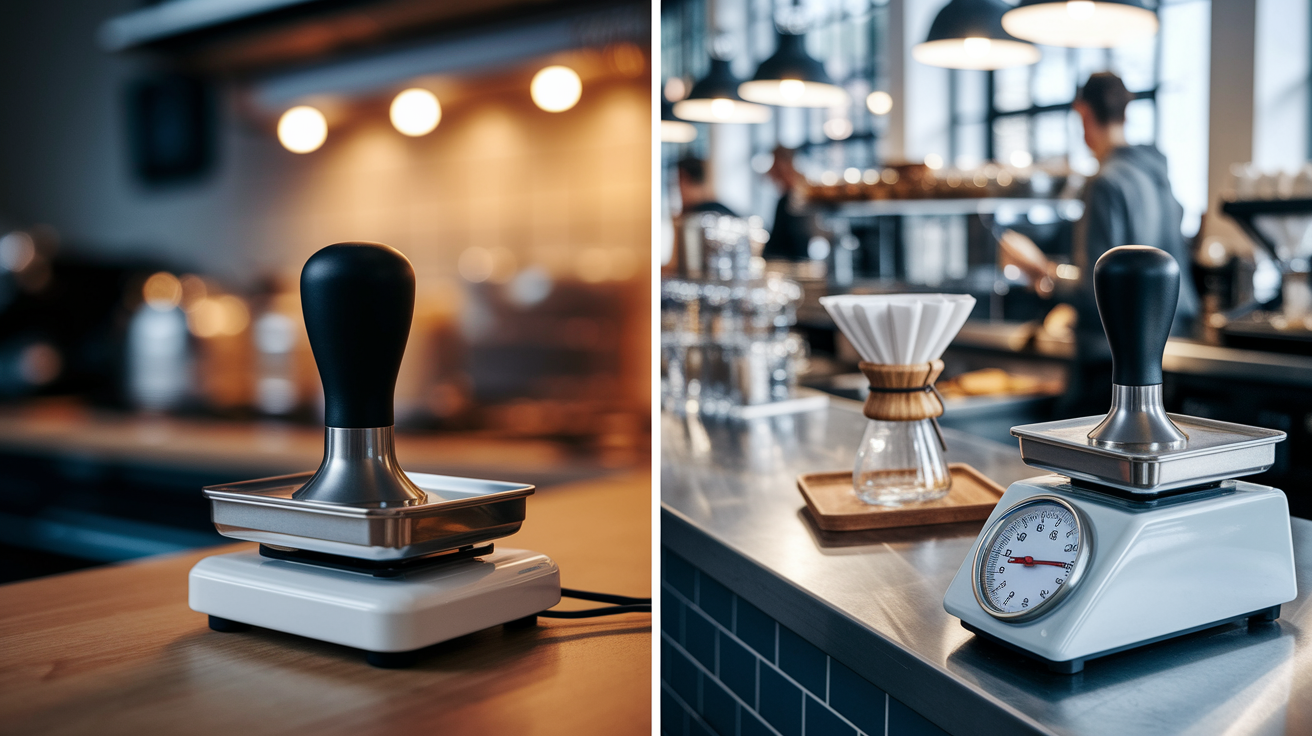
For home baristas pulling one to five shots per session, a medium-weight tamper in the 400 to 550 gram range offers the best balance of passive force and ergonomic comfort. These tampers contribute roughly one to one and a half pounds of gravitational force, making it easier to reach 30 pounds total without excessive arm effort, and their mass is high enough to resist small wrist tilts during the press. If you’re still learning technique and your shots vary widely in brew time, a slightly heavier tamper (500 to 600 grams) can tighten repeatability by reducing the influence of inconsistent arm pressure.
In a commercial café setting where baristas pull 50 to 200 shots per shift, ergonomics and speed matter as much as precision. A tamper in the 450 to 600 gram range hits the sweet spot: heavy enough to promote level, repeatable pressing without needing conscious effort on every pull, but not so heavy that it causes wrist or forearm fatigue after hours of continuous use. Some high-volume baristas prefer a lighter tamper (350 to 450 grams) because it allows faster hand movement between portafilter swaps, and they’ve developed strong muscle memory that compensates for the lower passive force. The key is consistency across the team. If multiple baristas share equipment, standardizing tamper weight and training everyone to the same target force (verified on a scale during onboarding) reduces shot-to-shot scatter more effectively than letting each person choose their own tool and guess at pressure.
Recommended tamper weight ranges by barista profile:
Beginner or learning technique: 500 to 650 grams. Extra mass improves leveling stability and reduces the learning curve for applying repeatable force. Home enthusiast or low volume: 400 to 550 grams. Balanced passive force and ergonomic comfort for occasional pulling, easy to control without fatigue. Commercial café or high volume: 450 to 600 grams. Enough stability for speed and repeatability without causing wrist strain over long shifts. Competition or precision-focused: 600 to 750 grams. Maximum inertial stability for ultra-consistent pressing. Acceptable fatigue trade-off when shot count is low and every pull is dialed to the gram.
Final Words
Pull a shot with focus: dose, distribution, then a steady tamp. That order matters more than how heavy the tamper is.
The data showed tamp pressure (5–20 kg) barely moved TDS. A heavier tamper just makes your tamping more stable. Fix grind and distribution first, then pick a tamper that feels repeatable.
This is how tamper weight influences puck compaction and extraction: it helps stability and repeatability, but won’t save a poorly distributed puck. One change at a time, and you’ll see steady gains.
FAQ
Q: How much force should you tamp with and does tamping pressure matter?
A: The force you should tamp with is about 30 pounds (≈14 kg) as a practical default. Tamping pressure matters less than a level, consistent tamp and good distribution; tests show little extraction change across 5–20 kg.
Q: How to tamp a puck?
A: To tamp a puck, dose and level the coffee, use a distribution tool or WDT to break clumps, then tamp level with steady pressure (about 30 lb), polish once, and wipe the basket rim before brewing.
Q: Why is tamping important?
A: Tamping is important because it compacts the coffee into an even puck that creates consistent resistance, helping water flow evenly, reduce channeling, and produce balanced extraction with steadier flavor.