


Is 25 to 30 seconds really the magic window for an 18 g double basket? Yes—and it makes the difference between sour, thin shots and sweet, full-bodied espresso.
Dose 18 g, pull 36 g (1:2), and you’re aiming for that 25–30 second stretch.
This post gives clear time targets, explains the handful of variables that shift a shot by seconds, and shows one simple adjustment to try first so you can repeat the result at home or behind the bar.
Core Time Targets for 18g Double Baskets
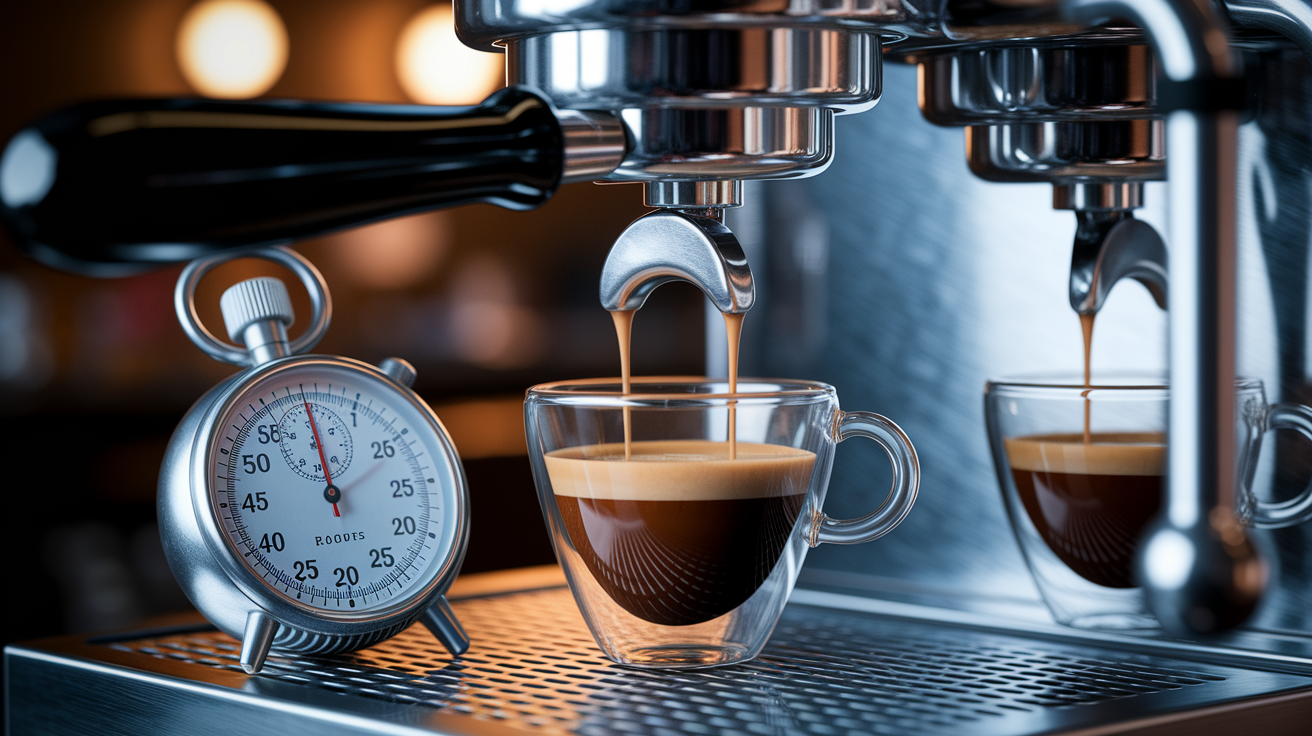
You’re aiming for 25 to 30 seconds from pump activation to stop. That’s your sweet spot. Dose 18 g, pull until you collect 36 g of liquid, and you’ve got a 1:2 brew ratio that extracts enough sugars and oils without crossing into harsh territory.
Anything under 20 seconds tastes sour and weak. Water’s racing through the puck before it can dissolve much of anything. Go past 35 seconds and you’re pulling bitter, burnt notes that dry out your palate. Between 25 and 30 seconds, acids, sugars, and oils balance into something rich and satisfying. Light roasts sometimes stretch to 30 to 35 seconds to bring out sweetness. Turbo shots run fast on purpose, around 15 to 20 seconds, using coarser grinds and higher pressure for bright, fruity results.
Quick timing cues:
- Under 20 seconds – Sour, thin, pale crema
- 25 to 30 seconds – Sweet, full body, thick golden crema
- Over 35 seconds – Bitter, dry, astringent
- Pre-infusion machines – Total time can hit 35 to 40 seconds, but extraction itself is still 25 to 30 seconds
- Typical yield volume – 50 to 60 ml (1.7 to 2.0 fl oz) for a double
Extraction Variables That Influence 18g Basket Timing
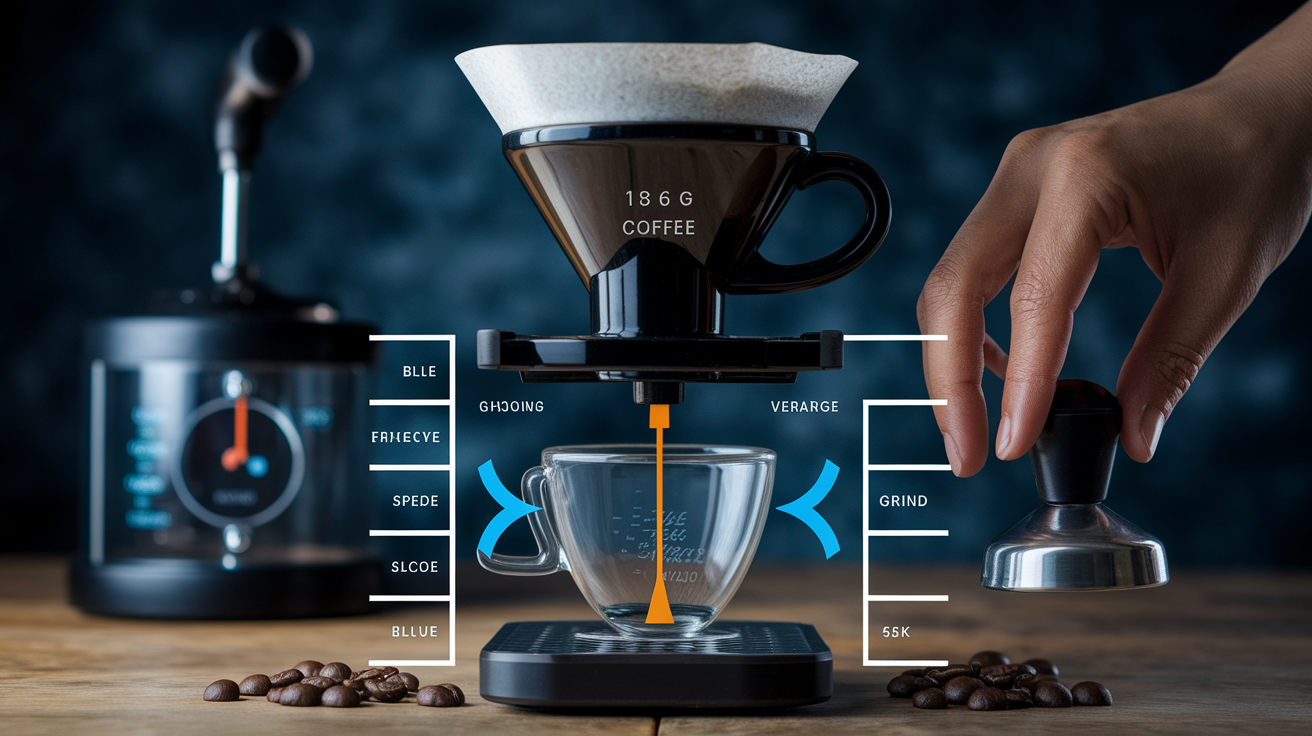
Grind size controls speed. Go finer and you add 3 to 5 seconds. Go coarser and you shave off the same amount. Most dialing happens right here.
Dose and tamp pressure create flow resistance together. An 18 g dose in a precision basket leaves just enough headspace for even saturation. Tamp with around 30 lbs of pressure and you compress the puck uniformly, which prevents channeling. Uneven tamping creates soft spots where water rushes through, cutting your shot time and leaving you with sour, uneven extraction. Higher doses (19 to 20 g) slow things down by a few seconds even if grind stays the same.
Water temperature and brew pressure define the energy and force behind extraction. You want 90 to 96°C. Cooler water slows dissolving and can leave shots tasting sour. Hotter water speeds extraction and risks bitterness. Brew pressure should sit around 9 bar during the main phase. Machines that hold stable pressure deliver consistent flow rates, which keeps your timing predictable.
Pre-infusion adds a low-pressure saturation phase before full extraction begins. Typical pre-infusion runs 0 to 5 seconds, but some machines extend it to 5 to 10 seconds or longer. If you measure total shot time from pump activation, pre-infusion counts toward your 25 to 30 second target. If your scale auto-starts the timer at first drip, the displayed time will be shorter, usually around 20 to 25 seconds, because it skips the pre-infusion phase. Always clarify your timing method so you know whether pre-infusion is included or excluded.
Timing Stages of an 18g Double Shot

Every shot moves through three phases:
- Pre-infusion (0 to 5 seconds) – Low-pressure water saturates the puck, expands grounds slightly, prevents dry pockets that cause channeling.
- Dissolution (6 to 20 seconds) – Full brewing pressure dissolves sugars, acids, and aromatic oils. Body and sweetness develop fast during this window.
- Final extraction (21 to 30 seconds) – Heavier oils, crema-building compounds, and some astringent notes join the liquid. Stopping here balances richness without bitterness.
During dissolution, you’ll see a thick, dark stream with a caramel-brown color and visible striping called “tiger striping.” Crema should appear within the first few seconds and build steadily into a golden foam layer. If your shot lightens to pale blonde before 20 seconds, water is moving too fast and you’re under-extracting. If the stream stays dark and syrupy past 30 seconds, you’re over-extracting.
Watch the flow rate and color transitions. A shot that suddenly sprays or streams unevenly mid-pull signals channeling. Water found a crack and is rushing through one section of the puck. This usually happens because of poor distribution or uneven tamping, and it throws off your timing by creating a mix of over-extracted and under-extracted zones.
Crema texture also acts as a timing cue. Properly extracted shots produce thick, lasting crema with fine bubbles and a reddish-brown hue. Thin, pale crema that disappears quickly indicates under-extraction and fast flow. Very dark, dry-looking crema with large bubbles suggests over-extraction and slow flow.
Dialing In Shot Time for an 18g Espresso Recipe

Start with a consistent baseline: dose exactly 18 g, distribute the grounds evenly, tamp with steady pressure, and aim for 36 g of liquid output. Set your timer to start when you press the brew button. If your machine has a noticeable pre-infusion phase, note how long it lasts so you can interpret your total time correctly. Run the shot and stop when your scale reads 36 g.
Shot finishes before 25 seconds? It’s running too fast. Grind finer to slow the flow. Takes longer than 30 seconds? It’s running too slow. Grind coarser to speed it up. Make small adjustments, usually one or two clicks on a stepless grinder or one notch on a stepped grinder. Pull another shot after each change and check the time again. When you land inside 25 to 30 seconds, taste the espresso. If it’s balanced, sweet, and full-bodied, you’ve dialed in.
Keep dose and tamp pressure constant while you adjust grind. Changing multiple variables at once makes it impossible to know which shift caused the improvement or problem. If you’re still getting sour or bitter shots even after hitting the 25 to 30 second window, adjust your yield slightly. Pull a bit shorter for a ristretto or a bit longer for a traditional double, but keep grind and dose steady so you can isolate the effect.
Machines with significant pre-infusion may show total times of 35 to 40 seconds even though the active extraction phase only lasted 25 to 30 seconds. Some digital scales auto-start the timer at first drip, which means your displayed time will be shorter than the full pump-on duration. Always clarify your timing method and stay consistent so your records mean the same thing.
| Dose | Yield | Time Target |
|---|---|---|
| 18 g | 36 g | 25–30 seconds |
| 18 g | 45 g (lungo) | 40–60 seconds |
| 18 g | 25 g (ristretto) | 15–20 seconds |
| 18 g | 50–60 ml (traditional double) | 25–30 seconds |
Basket, Portafilter, and Hardware Factors Affecting Timing

Precision baskets improve flow consistency by using uniform hole patterns and controlled depth. Standard baskets often have irregular hole spacing or slightly uneven surfaces, which creates micro-channels that speed up certain sections of the puck. Switching to a precision basket like those from VST or IMS can tighten your timing variance by a few seconds and make dialing more predictable.
Basket depth and hole count change how much resistance the puck creates. Deeper baskets with more vertical space let you dose higher without compressing grounds too tightly, which can slow extraction slightly. Baskets with more holes distribute pressure more evenly, reducing the chance of channeling and keeping flow rates stable. Portafilter size also plays a role. 58 mm portafilters create wider, flatter pucks that extract more uniformly than smaller 54 mm or 51 mm formats.
Check these hardware details if timing becomes inconsistent:
- Basket certification – Precision-machined baskets reduce shot-to-shot variance
- Hole pattern uniformity – Even spacing prevents fast channels and slow zones
- Basket depth – Deeper baskets accommodate higher doses without choking flow
- Portafilter diameter – Larger diameters (58 mm) support more even saturation and extraction
Visual and Sensory Indicators That Confirm Time Targets Are Correct

Even when your timer reads 25 to 30 seconds, you need to confirm that extraction quality matches. Look at the stream as it flows into your cup. A properly extracted shot starts with a thick, dark drip that quickly forms a steady stream with visible striping. Crema should appear early and build into a golden foam layer at least a few millimeters thick. The stream should remain consistent in color and thickness until you stop the shot.
Taste the espresso and check for balance. A dialed-in shot tastes sweet with pleasant acidity, full body, and a clean finish. Under-extracted shots hit your palate with sharp sourness, thin texture, and weak flavor that fades quickly. Over-extracted shots taste dry, bitter, and astringent, often leaving a burnt or ashy aftertaste.
Use these visual and flavor markers to validate your extraction:
- Under-extraction (fast, under 20 seconds) – Pale, thin crema. Watery mouthfeel. Sour, weak flavor. Stream that starts light and stays thin.
- Balanced extraction (25 to 30 seconds) – Thick golden crema with reddish-brown highlights. Full body. Sweet, rounded flavor with balanced acidity. Stream that shows tiger striping and consistent flow.
- Over-extraction (slow, over 35 seconds) – Very dark or dry-looking crema with large bubbles. Heavy, dry mouthfeel. Bitter, burnt, or astringent flavor. Stream that slows to a drip and lightens to pale blonde late in the shot.
- Channeling (inconsistent time) – Uneven crema with holes or white spots. Sharp, unbalanced flavor. Stream that sprays or pulses instead of flowing smoothly.
- Proper body and mouthfeel – Syrupy texture that coats your tongue. Lingering sweetness. Clean aftertaste with no dryness.
- Ideal aroma – Rich, caramel, or chocolate notes (medium/dark roasts). Fruity or floral notes (light roasts). No burnt or grassy smells.
Numbers tell you if you’re in the ballpark, but your senses confirm whether the shot is actually dialed. If timing looks good but taste doesn’t match, adjust yield or temperature before questioning your grind.
Troubleshooting Timing Issues With 18g Double Baskets

When shots run too fast, grind finer to increase resistance and slow the flow. If they run too slow, grind coarser to open pathways for water. If timing jumps around unpredictably, the problem usually lies in distribution or tamping rather than grind size. Channeling creates fast lanes through the puck, which lets water bypass most of the coffee and finish the shot early even though parts of the puck stay dry.
| Problem | Likely Cause | Fix |
|---|---|---|
| Shot finishes in under 20 seconds | Grind too coarse; dose too low; uneven tamp | Grind finer; confirm 18 g dose; check tamp consistency |
| Shot takes over 35 seconds | Grind too fine; dose too high; excessive tamp pressure | Grind coarser; reduce dose to 18 g; ease tamp pressure |
| Timing varies plus or minus 5 seconds shot-to-shot | Channeling from poor distribution; uneven tamp; stale beans | Use WDT tool; tamp level and consistent; check bean freshness |
| Correct time but sour taste | Water temperature too low; under-roasted beans; incorrect ratio | Increase brew temp 1 to 2°C; try longer yield (1:2.5); verify roast profile |
Environmental factors shift grind behavior day to day. High humidity makes coffee absorb moisture, which clumps grounds and slows extraction. You may need to grind slightly coarser in humid weather. Low humidity dries beans out, which can speed flow and require a finer grind. Bean age also matters: fresh beans release CO₂ during extraction, which adds resistance and slows the shot, while older beans flow faster and may need a finer grind to compensate.
Track these environmental variables to catch timing drift before it ruins your shots:
- Humidity changes – Adjust grind finer in dry conditions, coarser in humid conditions
- Ambient temperature – Cold grinders and cold beans slow extraction slightly. Warm machines speed it.
- Bean age – Fresh beans (within 2 weeks of roast) slow flow. Older beans speed it.
- Grinder retention – Leftover grounds from previous settings can contaminate your current shot. Purge a few grams after adjusting.
If you’ve checked grind, distribution, tamp, and environmental factors but timing still won’t stabilize, inspect your basket for clogs or buildup. Old coffee oils and micro-fines can block basket holes and create uneven flow. Soak the basket in espresso cleaner weekly and backflush your machine to keep the group head clean.
Advanced Adjustments for Specific Flavor Goals

Light roasts often need longer extraction times to fully develop sweetness and complexity. If you’re pulling a light roast and getting bright, fruity acidity but thin body, extend your shot to 30 to 35 seconds or even longer. The extra time dissolves more sugars and balances the natural acidity without pushing into bitterness, because lighter roasts contain fewer bitter compounds to begin with. You may also increase your yield to 1:2.5 or 1:3 (18 g in, 45 to 54 g out) to build body and sweetness.
Dark roasts carry more soluble bitters and roasted oils, so they benefit from shorter extractions. Pulling a dark roast for the full 30 seconds can make the cup taste burnt, ashy, or overwhelmingly bitter. Aim for 22 to 27 seconds and stop the shot as soon as you see the stream begin to lighten. You can also pull a shorter yield, around 1:1.5 (18 g in, 27 g out), to concentrate sweetness and minimize harsh notes.
Milk-based drinks like lattes and cappuccinos need espresso with enough sweetness and body to punch through dairy. Many baristas extend yield slightly, pulling 40 to 45 g instead of 36 g, to increase sweetness and reduce sharpness. This longer yield still finishes within 25 to 30 seconds if you adjust grind to maintain flow rate. The extra liquid dilutes intensity just enough to blend smoothly with steamed milk without disappearing.
Consistency Methods for Repeating 18g Shot Time Targets
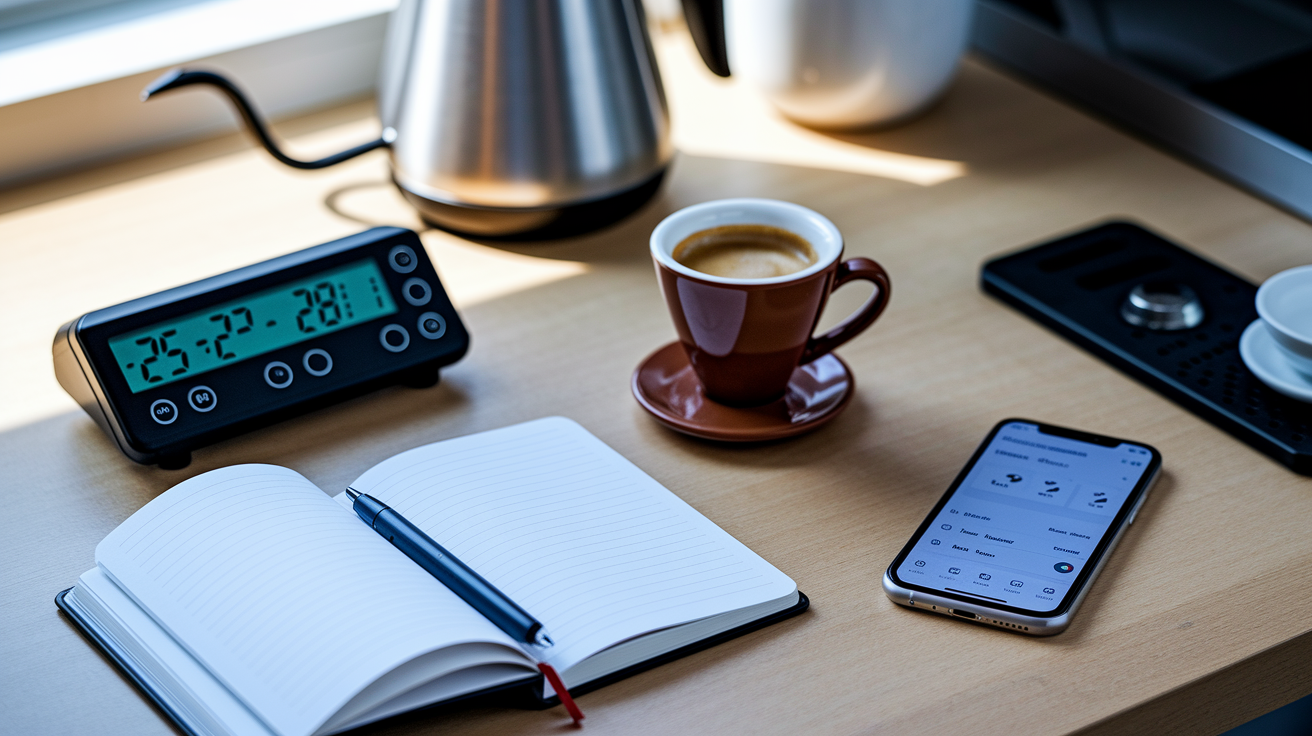
Accurate timing requires a reliable scale with a built-in timer or a separate shot timer that starts when you press the brew button. Scales that auto-start at first drip can simplify workflow, but you need to remember they’re measuring extraction-only time and not including pre-infusion. Pick one timing method and stick with it so your logs stay consistent.
Record every dial-in session in a simple spreadsheet or notebook. Write down dose, yield, grind setting, time, water temperature (if adjustable), and tasting notes. When you drift off target a few days later, you can compare current numbers to your baseline and spot which variable changed. Tracking also helps you notice patterns, like needing to grind finer every Monday after the weekend, or adjusting coarser on humid afternoons.
Use these consistency practices to lock in repeatable 25 to 30 second shots:
- Warm up your machine for at least 15 minutes before pulling shots. Stable temperature prevents timing drift.
- Purge the group head before every shot to flush stale water and stabilize brew temperature.
- Dose by weight every time. Volumetric dosing (filling the basket by sight) creates 1 to 2 g variance that throws off timing.
- Use a timer that starts at pump activation or first drip. Be consistent so your data matches your method.
- Log grind changes immediately. Note whether you went finer or coarser and by how many clicks, so you can reverse bad adjustments quickly.
Smartphone apps and shot-tracking software can automate logging and even generate charts that show how timing trends over weeks. Some scales sync with apps via Bluetooth and log dose, yield, and time automatically. These tools help most in high-volume environments where multiple baristas pull shots and need to stay aligned on a shared recipe.
Final Words
Pull 18 g in and aim for about 36 g out in 25–30 seconds. That’s the core action: why 1:2 matters, how grind, tamp, temperature, and pre-infusion change timing, and which visual cues to watch—thick golden crema, steady thread-like flow.
If shots are too fast, grind finer. Too slow, go coarser. Change one thing at a time and record grams and seconds so you can repeat wins.
Use these baselines—especially the ideal shot time targets for 18g double baskets—and you’ll get more consistent, tasty shots.
FAQ
Q: How long should an 18g shot take?
A: An 18g shot should take about 25–30 seconds for a balanced 1:2 pull (18g in → ~36g out). Light roasts may need 30–35s; <20s usually tastes under‑extracted.
Q: What is the 15-15-15 rule for coffee?
A: The 15-15-15 rule for coffee is a simple starting protocol using three 15-second segments (common in workflow or dial-in steps) to simplify testing; treat it as a rough guide and adjust by taste.
Q: What is the 30 second rule for espresso?
A: The 30 second rule for espresso treats ~30 seconds as a benchmark for full extraction; aim 25–30s for balance, extend slightly for light roasts, shorten for darker roasts or turbo pulls.
Q: Is 20 seconds too fast for espresso?
A: A 20-second shot is usually too fast for a balanced 1:2 18g double and often tastes sour or thin. Grind finer or increase resistance unless you want a quick, turbo-style shot.