
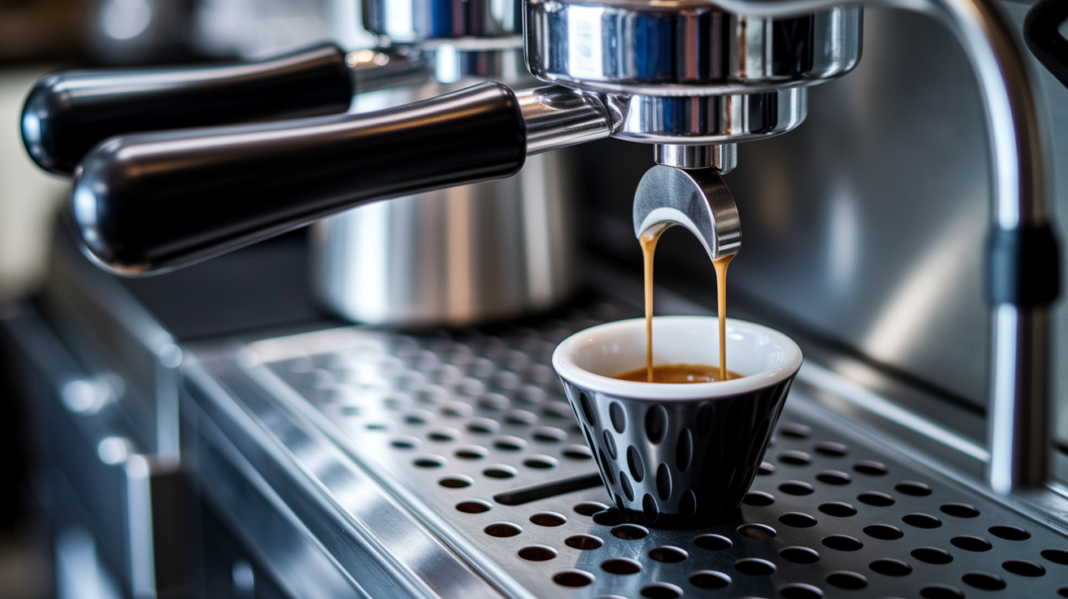

Which tamper actually makes better espresso — flat or convex?
Both can pull excellent shots, but they change how water moves through the puck and what your cup tastes like.
A flat base gives even compression and clearer, balanced notes when your distribution is precise.
A convex base softens the rim, cutting perimeter channeling and often making shots more forgiving during busy service.
Read on to see the visual cues, one simple tweak to test right now, and how to pick the tamper that matches your basket, dose, and workflow.
Extraction and Flavor Differences Between Flat and Convex Tampers
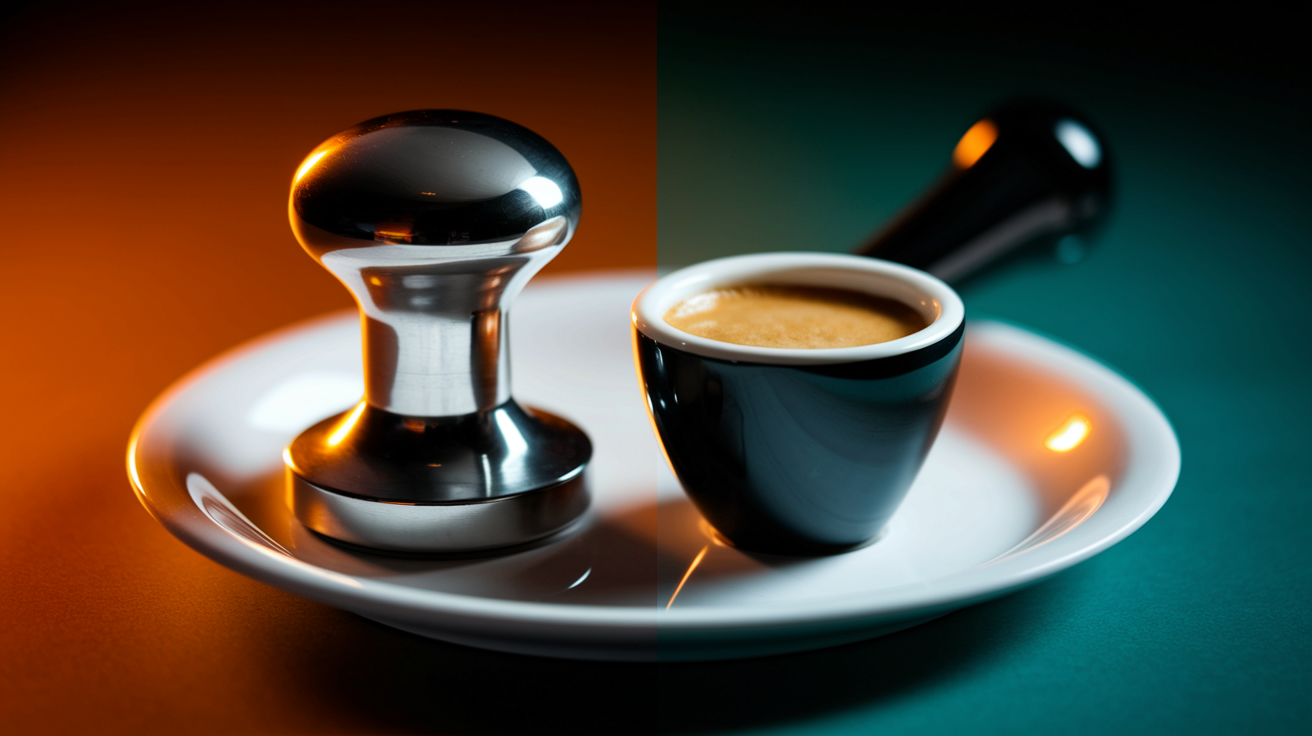
A flat tamper creates a level puck surface that pushes water outward in an even pattern. When the coffee bed compresses uniformly, extraction happens at roughly the same rate across the whole diameter. You get balanced sweetness, clear acidity, and fuller crema when your puck prep and grind are dialed in. But if your dose sits unevenly or the tamper doesn’t fit snugly in the basket, a flat base can over-compress the perimeter. That creates a hard edge seal that diverts water into weak spots, giving you over-extracted bitterness at the rim and sour, under-extracted channels through thinner areas.
A convex tamper hits the puck center first and leaves the outer edge a bit less dense. Water contacts that lower-resistance center before spreading toward the walls. The looser edge reduces the chance that the first crack forms at the basket perimeter, which helps prevent fast side-wall channeling. The trade-off? Your center may extract slightly faster, pulling more sweetness and lighter aromatics early while the rim adds body and darker roast notes later. In practice, this can make your shot taste brighter or more “front-loaded” compared to a flat-tamped puck using the same dose and grind.
Both shapes can pull excellent espresso when matched to your basket and used consistently. The sensory differences show up most clearly when you compare identical beans, dose, and grind side by side.
Flavor comparison at 18 g dose to 36 g yield in 28 seconds:
- Sweetness: Flat tampers often pull more balanced sweetness through the whole shot. Convex tampers may give you slightly brighter early sweetness followed by a heavier finish.
- Clarity: Flat bases tend to produce clearer, more defined flavor notes when puck prep is precise. Convex bases may blur mid-palate clarity a bit due to variable center vs. edge extraction rates.
- Body: Convex tampers can create slightly fuller body by drawing more solids from the rim later in the shot.
- Bitterness: Flat tampers risk edge bitterness if you over-compress at the walls. Convex tampers reduce edge over-extraction but may introduce center astringency if the dome is too pronounced.
- Crema: Flat-tamped shots typically show thicker, more uniform crema. Convex-tamped shots may display slightly mottled or thinner crema at the very center.
Physical and Mechanical Differences in Tamper Geometry
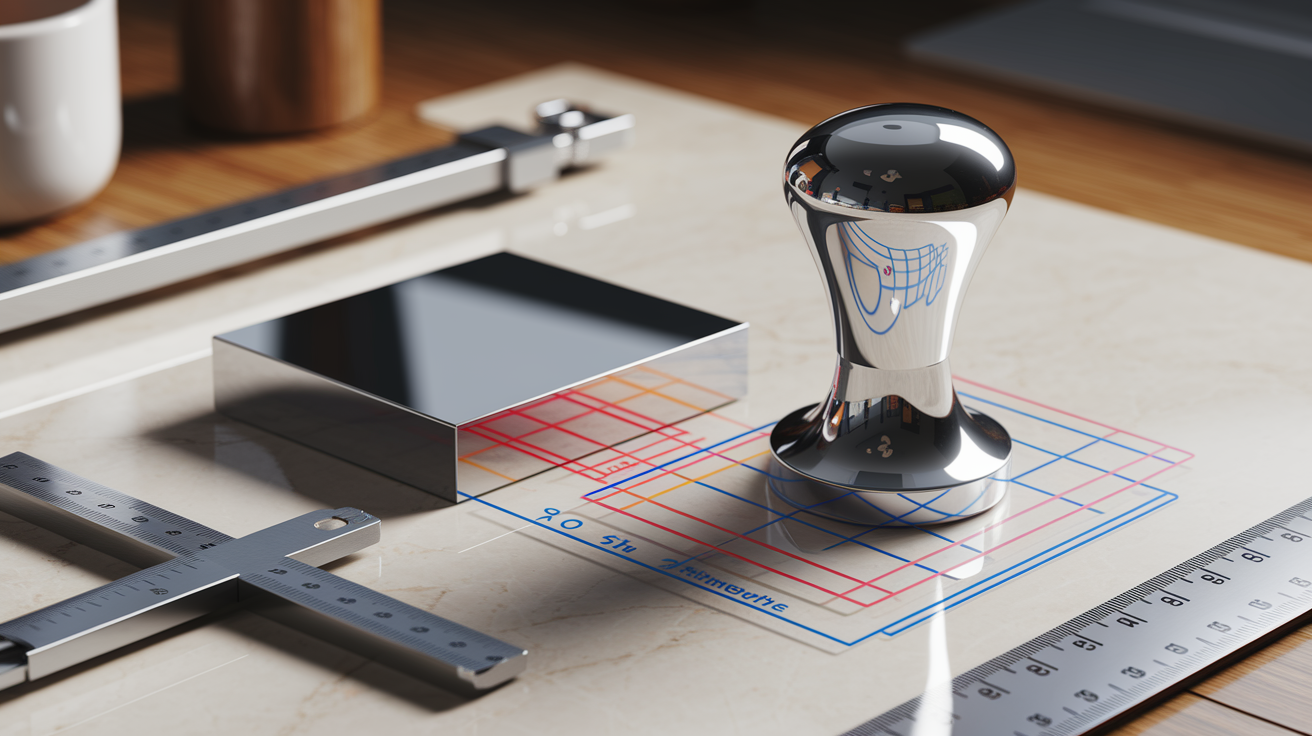
A flat tamper has a perfectly planar base that contacts the entire coffee surface at once. When you press down with steady force, compression distributes evenly across every square millimeter of the puck. This creates a uniform density field, assuming your coffee mound was level before tamping. The result is a flat top surface and consistent resistance to water flow.
A convex tamper features a base with a gentle dome, typically 0.5 to 2 millimeters of crown height at the center. When you press straight down, the center contacts first and compression radiates outward, pushing grounds toward the basket wall. This creates a puck that’s denser in the middle and slightly looser at the outer rim. The top surface after tamping will have a subtle dome shape, and that density gradient means water encounters different resistance zones as it flows through.
The geometry differences are small, but they directly change how tamp pressure turns into puck structure. A flat base acts like a piston in a cylinder, compacting everything uniformly. A convex base acts more like a gentle lens, redistributing coffee outward as it compresses downward. Both shapes can form a firm puck. The internal density map is just different.
| Feature | Flat Tamper | Convex Tamper |
|---|---|---|
| Base geometry | Planar surface, zero crown | Gentle dome, 0.5–2 mm crown |
| Pressure distribution | Uniform across entire puck | Concentrated at center, lower at rim |
| Puck surface after tamp | Flat, level top | Slight dome, center higher than edge |
| Edge density behavior | Can over-compress edge if basket fit is tight | Leaves edge looser, reduces edge sealing |
Water Flow Behavior and Channeling Risk
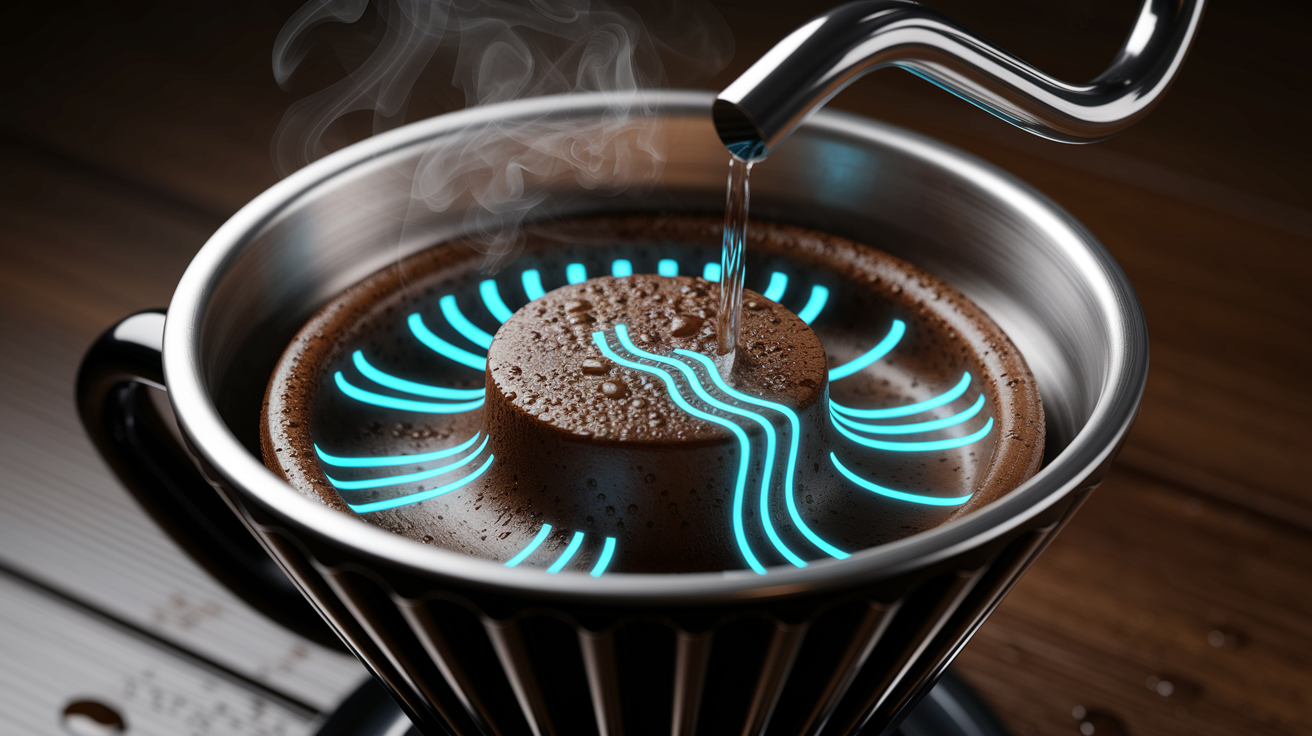
Water entering the puck from the shower screen moves through the path of least resistance. When the entire puck has uniform density, flow begins in the center and spreads radially outward in a controlled front. A flat-tamped puck encourages this ideal pattern, but only if the dose was evenly distributed and the tamper fits the basket within 0.1 to 0.3 millimeters. If there’s a gap between the tamper edge and the basket wall, or if the dose was higher at the rim, the flat base compresses that outer ring into a hard seal. Water then finds micro-cracks elsewhere, often a single channel that sprints through the center or a weak spot near the screw tab. The shot pours fast and thin.
A convex tamper reduces outer-edge density, so the highest-resistance zone sits in the middle of the puck rather than at the perimeter. This geometry discourages the classic edge-channeling pattern where water sneaks along the basket wall and bypasses most of the coffee. The looser rim acts as a buffer, slowing flow at the edge just enough to keep pressure more evenly distributed. The trade-off is that if your distribution was already good, the convex shape can reduce extraction efficiency slightly by under-compressing the rim and allowing water to flow too easily through that zone.
How each tamper shape affects channeling and flow uniformity:
- Flat tampers produce predictable radial flow when puck prep is clean, but amplify any edge-contact errors by creating a hard outer seal that forces channels inward.
- Convex tampers buffer edge-channeling risk by leaving the rim looser, which helps mask minor distribution mistakes and basket-fit gaps.
- Side-wall spurting, visible with a bottomless portafilter, shows up more often with flat tampers if the basket diameter and tamper diameter don’t match closely.
- Center-focused channels can appear with convex tampers if the dome is too tall or the dose is under-distributed, because the center becomes a high-speed lane.
- Combining WDT or distribution tools with either tamper shape reduces channeling more than switching tamper geometry alone. Flow uniformity starts with even particle placement before the tamp.
Technique Considerations for Flat vs Convex Tampers
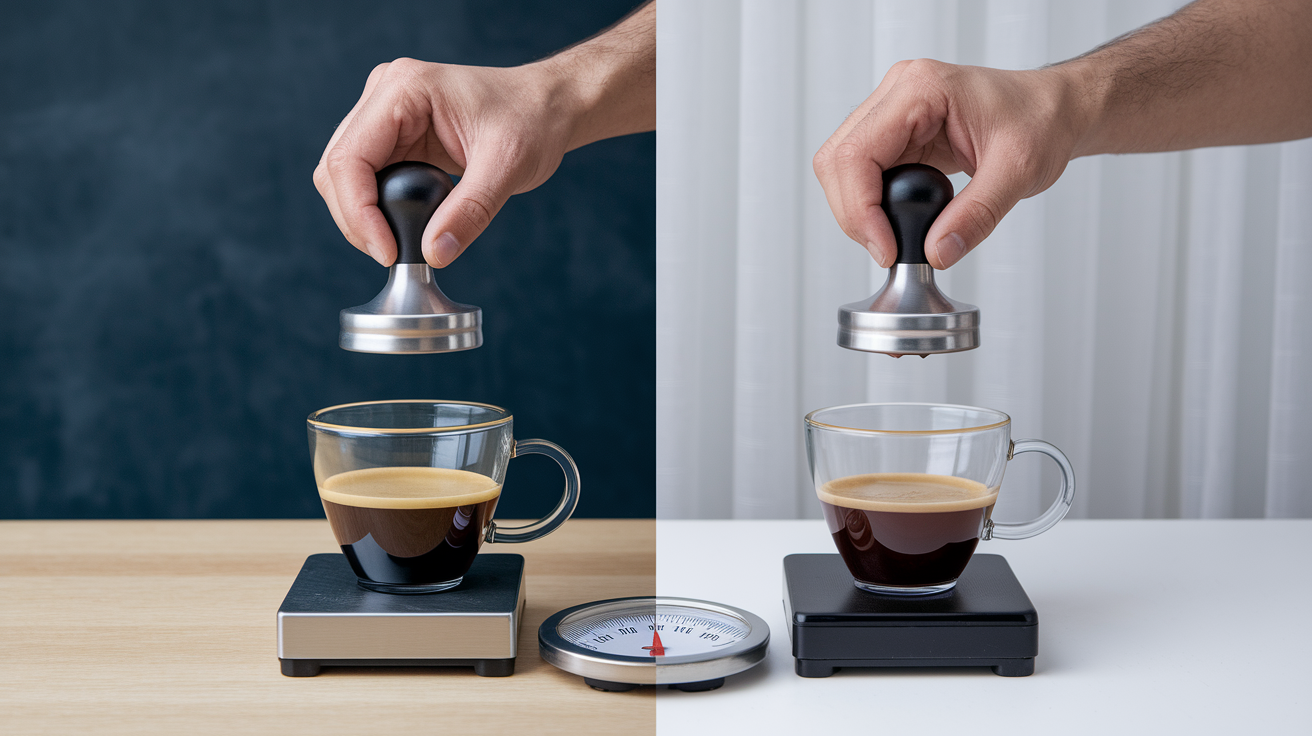
Using a flat tamper well means making sure the coffee mound is already level before you press. If one side of the dose sits higher, a flat base will compress that side more, creating a tilted puck and uneven flow. Many baristas lightly sweep the mound with a finger or use a leveling tool, then tamp straight down with steady, even force. The motion should feel like lowering a piston. No rocking, no angling. If the tamp isn’t perpendicular to the basket, you’ll compress one edge harder and leave the opposite side looser, which opens a direct path for channeling.
A convex tamper requires a slightly different focus. Because the center contacts first, you need to press straight down without tilting or the dome will land off-center and create an asymmetric density gradient. The rim will be looser on one side and tighter on the other, and water will preferentially flow through the looser zone. Convex tampers are often described as more forgiving for distribution errors, but they’re less forgiving for wobbly tamping motion. Keep your wrist locked, press with your shoulder and arm rather than your hand, and stop as soon as you feel firm resistance. Over-tamping with a convex base can flatten the intended dome and turn it into an uneven flat puck, losing the edge-buffering benefit.
Both shapes benefit from consistent pressure. A commonly cited baseline is 20 to 30 pounds of downward force, which translates to roughly 90 to 130 newtons. You don’t need to measure this every time, but practicing with a bathroom scale once or twice helps you learn what steady, repeatable pressure feels like. After that, focus on keeping your tamp motion identical shot to shot. Consistency in angle, speed, and force matters more than whether you push with 25 or 28 pounds. If you’re switching from a flat to a convex tamper or vice versa, expect to re-tune your grind and dose slightly. The puck resistance will change even if your tamping motion stays the same.
Pros and Cons of Flat and Convex Tampers
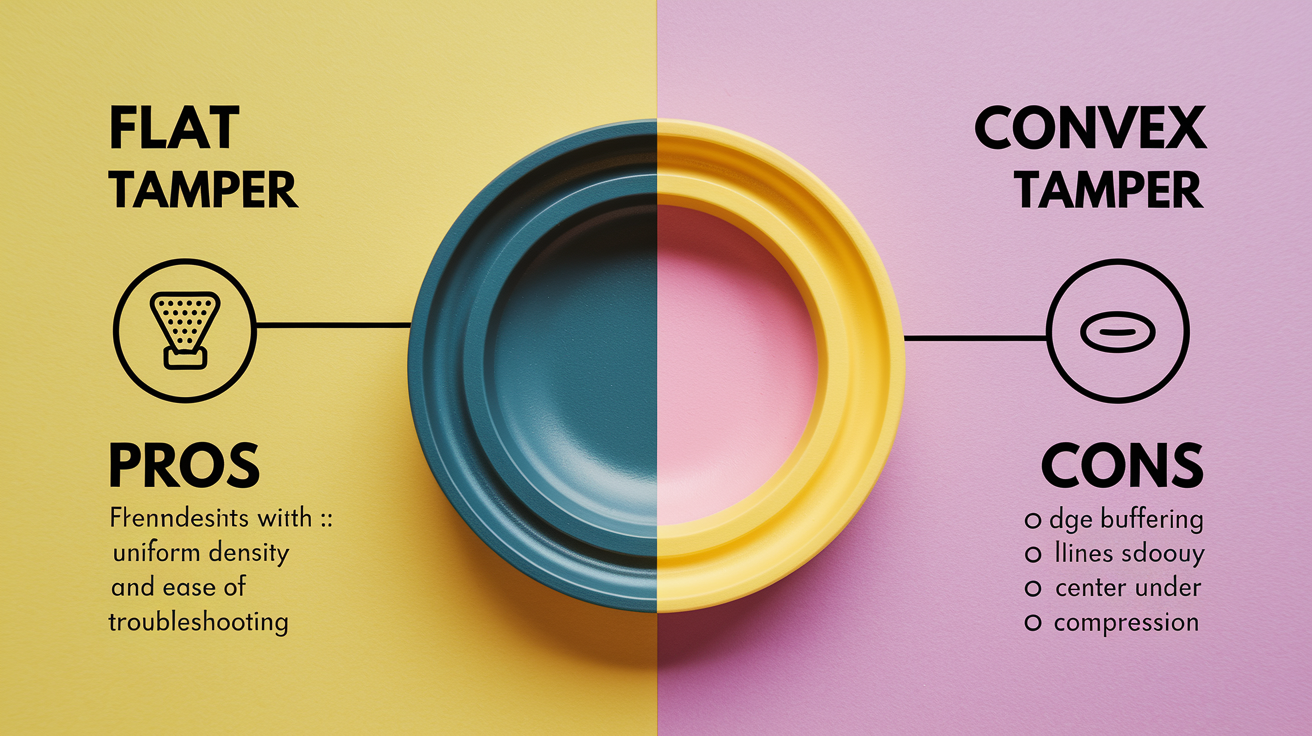
Flat tampers deliver predictable, uniform compression when paired with precise baskets and careful distribution. They make it easier to diagnose extraction problems because the puck geometry is simple and repeatable. Many competition baristas and home users who dial in with scales and timers prefer flat bases for that reproducibility. On the downside, flat tampers are less forgiving of basket-fit errors and uneven dose clumping. If your grinder produces static-clumped coffee or your WDT technique is inconsistent, a flat tamp can hard-seal those imperfections into the puck and amplify channeling.
Convex tampers help reduce side-wall channeling and can smooth out minor distribution mistakes by leaving the rim looser. They’re often recommended for setups where basket tolerances are wider or where dose consistency varies shot to shot. Some commercial cafés prefer convex tampers because they reduce the number of ruined shots during busy service. The disadvantages are less predictable extraction tuning and the potential for center under-compression if the crown height is too tall for the dose. Convex tampers also make it harder to visually confirm puck levelness after tamping, because the domed surface looks correct even when it isn’t.
Flat tamper strengths and weaknesses:
- Pro: Creates perfectly uniform puck density when distribution and fit are good.
- Pro: Easier to troubleshoot. Channeling points to a specific prep step.
- Pro: Works best with precision baskets (VST, IMS) and tight tamper-to-basket tolerances.
- Con: Amplifies edge over-compression if basket fit or dose leveling is off.
- Con: Less forgiving of clumpy grinds or rushed workflow.
- Con: Can produce side-wall spurting with bottomless portafilters if diameter clearance exceeds 0.3 mm.
Convex tamper strengths and weaknesses:
- Pro: Reduces edge-channeling risk by leaving the rim less dense.
- Pro: More forgiving of minor distribution errors and basket-fit gaps.
- Pro: Preferred in high-volume or less-controlled environments.
- Con: Can under-compress the puck center, risking fast center channels.
- Con: Harder to tune extraction precisely across different doses.
- Con: Domed puck surface makes it difficult to spot tilt or unevenness visually.
Choosing the Right Tamper for Basket Type and Skill Level
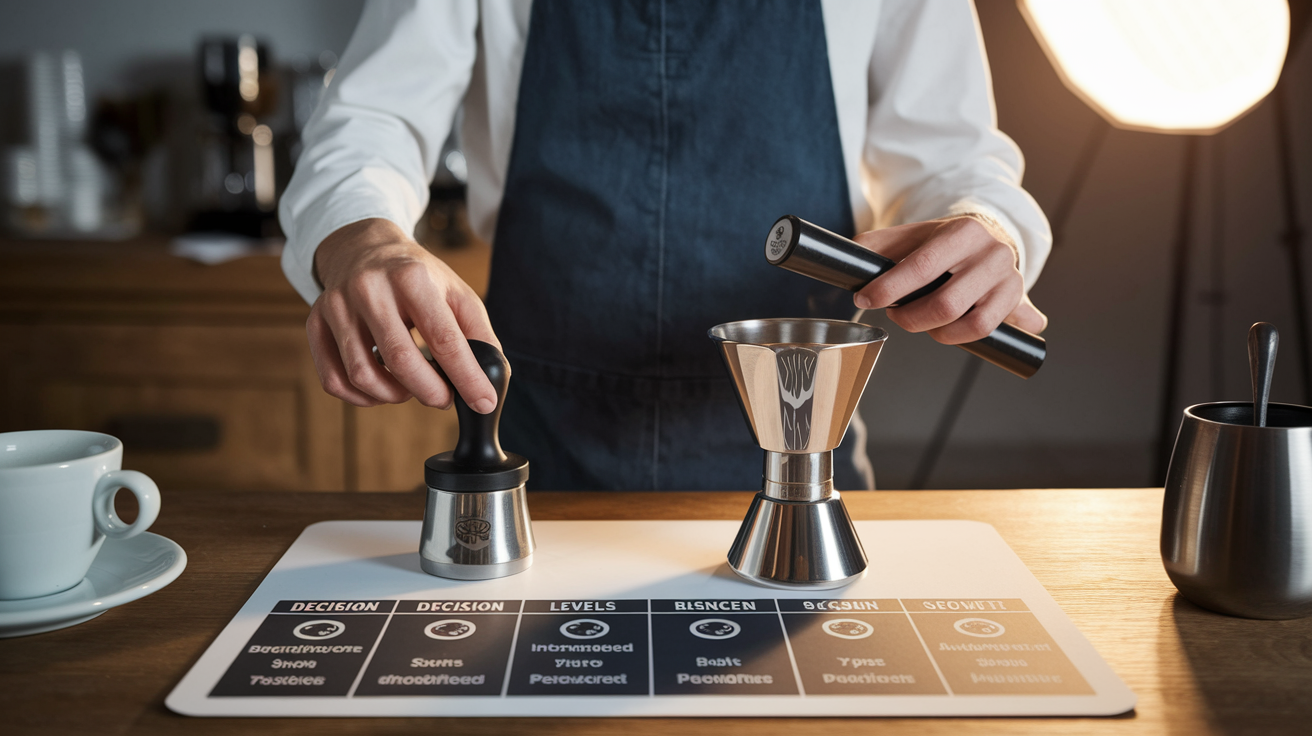
Precision baskets with tight internal tolerances, such as VST, IMS, or Pullman, are engineered for repeatable, even extractions. These baskets pair best with flat tampers because the goal is uniform density and predictable flow. When the basket internal diameter is machined to within 0.1 millimeters and the holes are laser-cut in a radial pattern, a flat tamp leverages that precision. If you’re logging doses, yields, and times with a scale and timer, a flat tamper gives you cleaner data and fewer confounding variables. Most home baristas who invest in precision baskets and single-dose grinders will see better shot-to-shot consistency with a flat base.
Non-precision or stock baskets that ship with espresso machines often have wider tolerances, slightly tapered walls, or uneven hole patterns. In these setups, a convex tamper can help compensate for basket inconsistencies by reducing the hard edge seal and buffering minor flow irregularities. If you’re working with a pressurized or double-wall basket, tamper shape matters less than dose and grind, but switching to a convex tamper when you upgrade to a single-wall basket can reduce early frustration with channeling. The looser rim acts as a safety margin while you’re still learning distribution and leveling technique.
Recommendations by skill and setup:
- Beginners or users with stock baskets: Start with a convex tamper to reduce edge-channeling frustration. Prioritize learning consistent dose and grind before worrying about tamp shape.
- Intermediate baristas with precision baskets and a scale: Switch to a flat tamper to unlock better extraction control and clearer feedback when dialing in. Pair it with WDT or a distribution tool.
- Advanced users chasing specific flavor profiles: Test both shapes side by side with the same dose and grind. Choose flat for maximum clarity and repeatability, or convex if you prefer slightly fuller body and want to minimize edge over-extraction.
Final Words
Pull two quick test shots and watch the flow. Note where the stream starts at 10 seconds, what the puck looks like, and how the cup tastes. That’s your data.
Change only the tamper next. Keep dose, grind, and tamp pressure the same. Taste both and write down time, yield, and obvious notes: sweeter, bitter, thin, or syrupy.
Simple rule: flat for precision baskets and clarity, convex to ease edge compaction. Testing will reveal the flat vs convex tamper extraction differences for your setup — and you’ll land on a better, repeatable shot.
FAQ
Q: What is the difference between flat and convex tamper, and why should you tamp the coffee to make it flat?
A: The difference between flat and convex tampers is that flat bases create an even, level puck for uniform water flow, while convex ones leave a slight dome to reduce edge density; tamping flat gives more predictable, even extraction.
Q: What are the different types of tampers?
A: The different types of tampers are flat, convex (domed), calibrated/pressure-control, levelling or distributor-tamper hybrids, and adjustable-depth or palm tampers for different baskets and workflows.
Q: What are the different types of tamping machines?
A: The different types of tamping machines are manual lever or bench tampers, semi-automatic calibrated pressure stations, pneumatic/electric automatic tampers, and integrated espresso machines with built-in tamping.