


Think any tamper will do? Think again.
A tamper even a fraction off can scrape the basket or leave a soft ring and wreck shots.
Measure the inner diameter of the basket — not the handle — and choose a tamper about 0.1 to 0.3 mm smaller.
I’ll walk you through quick, repeatable steps using calipers, a simple roundness check, and the one measurement rule that fixes most fit problems.
No guesswork, no hunting for a mythical perfect tamper.
How to Measure Your Portafilter for Perfect Tamper Fit
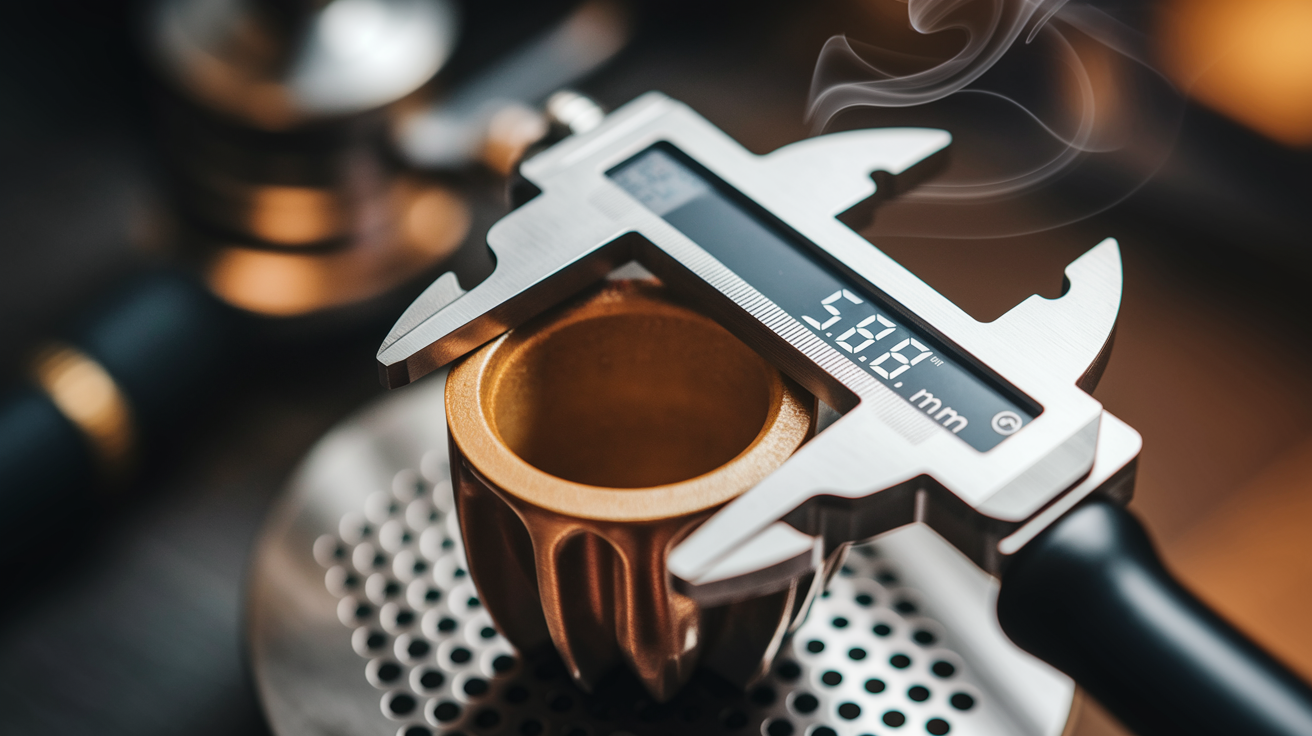
Measuring your portafilter basket is the only way to know your tamper will actually fit. A tamper that’s too big will scrape and bind. Too small, and you’re leaving unpressed coffee at the rim, which means channeling and sour shots.
You’re measuring the inner diameter of the basket itself, not the portafilter handle. Most home machines sit somewhere between 51 mm and 58 mm, but that doesn’t matter. The only number that counts is yours. Digital calipers are your best bet. They read to 0.1 mm and fit inside the basket without guessing. A ruler can work in a pinch, but you’ll lose precision and probably your patience.
- Pull the basket out and wipe the rim clean. Get rid of leftover grounds or oil.
- Zero your calipers, then place the jaws across the inside rim at the widest point.
- Write down the reading. Something like 58.0 mm or 53.3 mm.
- Rotate the basket 90 degrees and measure again. You’re checking if the basket is actually round.
- If the two numbers differ by more than 0.3 mm, go with the smaller one.
- Measure once more about 4 or 5 mm down the wall to see if there’s a taper.
Once you’ve got the inner diameter, subtract 0.1 to 0.3 mm to find your tamper size. A 58.0 mm basket pairs well with a 57.7 mm or 57.8 mm tamper. If you measured 54.0 mm, look for a 53.7 mm or 53.8 mm tamper. Some people chase “precision fit” tampers that match the basket exactly, but unless your basket is perfectly round and spotless, you’ll end up with scraping.
For a detailed breakdown of sizes by machine brand, check out this Size chart: find the size of your portafilter.
Common Portafilter Diameters and Their Matching Tamper Sizes

Most baskets fall into four standard sizes. Entry machines from De’Longhi and some Gaggia models run smaller. Mid-range stuff from Breville and Sage usually lands around 53 to 54 mm. Prosumer machines with E61 groups and commercial setups stick to 58 mm. Your machine category gives you a starting point, but measure anyway.
For more on checking your specific basket, see How do I know the size of my portafilter basket.
| Portafilter Diameter | Common Machines | Recommended Tamper Size |
|---|---|---|
| 49–51 mm | De’Longhi Dedica, La Specialista, some older Gaggia models | 50.7–50.9 mm (for 51 mm baskets) |
| 53–54 mm | Breville Barista Express, Barista Pro, Sage Bambino, Duo-Temp | 53.3 mm or 53.7–53.8 mm |
| 58 mm | E61 machines (Bezzera, ECM, Rocket), Rancilio Silvia, Gaggia Classic, Breville Dual Boiler | 57.7–57.8 mm |
| 57 mm | La Pavoni (some models), Cimbali (older brew groups) | 56.7–56.8 mm (check availability; custom may be needed) |
Understanding Tamper Fit: Precision, Clearance, and Performance

Clearance is the gap between your tamper edge and the basket wall. Most people shoot for 0.1 to 0.3 mm. Thin enough to press coffee all the way to the edge, wide enough that the tamper slides in and out without dragging.
A tamper that’s too tight scrapes the walls on the way down. You’ll feel it catch, and pulling it out becomes a fight. Over time you might scratch the basket or leave metal shavings in your puck. Worse, it kills consistency because you’re wrestling friction instead of pressing evenly.
A tamper that’s too loose leaves a ring of soft coffee around the rim. Water hits that weak spot first and tears through it, pulling sour espresso from the gap while the center sits dry. You’ll see it clearly with a bottomless portafilter. One side sprays, the other flows clean. Even a 0.5 mm gap can wreck your shot.
Visual Reference: What a Correct Measurement Looks Like
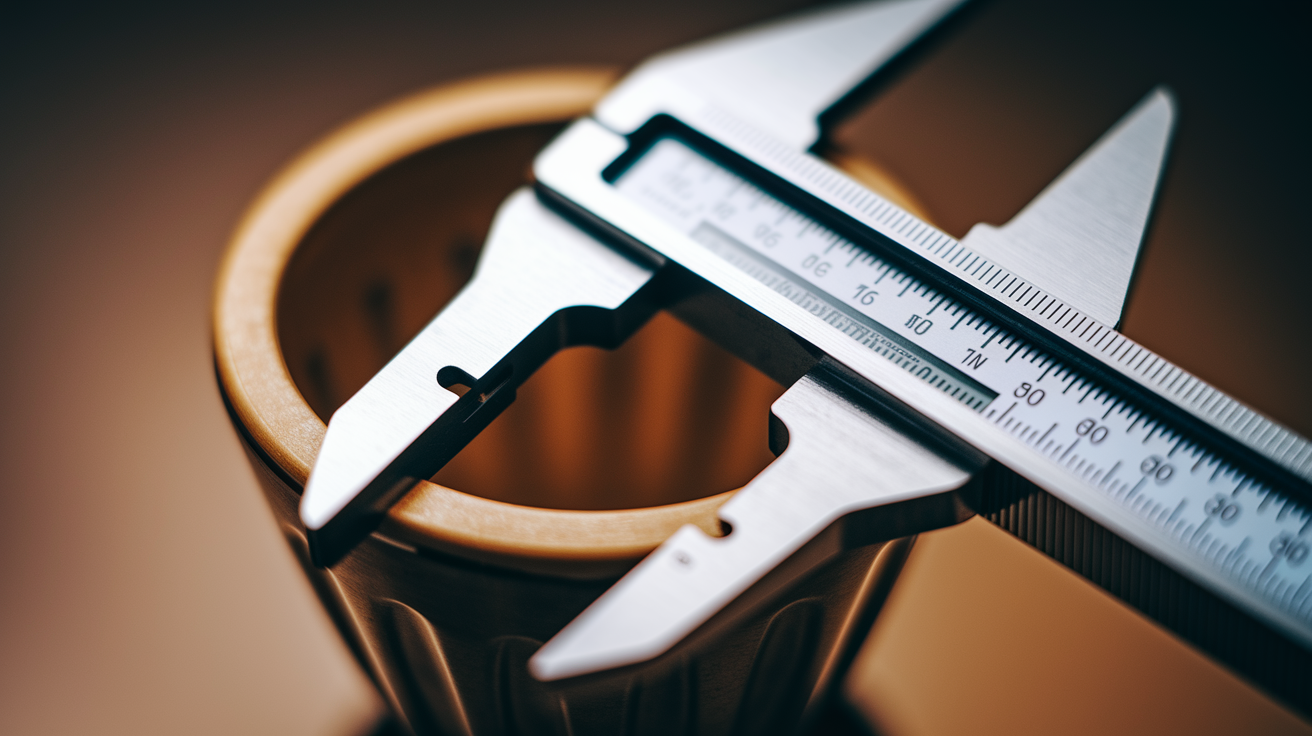
Put your calipers inside the basket so the jaws touch the inner walls at the widest point. The measurement line should run straight across the center, not angled. If the jaws tilt or snag on the lip, you’re measuring in the wrong spot.
Many baskets taper slightly, wider at the top and narrower a few millimeters down. Measure at the top rim where the tamper sits, not halfway down the wall. That’s where clearance matters. If your basket has an internal step or lip, note where it starts. Some tampers come with a beveled edge to avoid catching.
- Rest the jaws flat against the walls, not tilted.
- Measure straight across the center for the true diameter.
- Rotate 90 degrees and measure again to catch any weirdness in the shape.
Final Words
Measure the inner diameter at the top interior edge with calipers, and aim for 0.1-0.3 mm clearance between basket and tamper. That single check fixes most fit problems.
You saw how calipers give the tightest accuracy, how to round when using a ruler, and which common diameters pair with which tampers. Do one change at a time: measure, match, test.
If you want a simple next step, follow the how to measure portafilter for correct tamper size routine — check with calipers, pick a tamper 0.1-0.3 mm smaller, and pull a test shot. You’ll see steadier flow and better shots.
FAQ
Q: How do I know what size tamper I need?
A: The tamper size you need equals your portafilter basket’s inner diameter minus about 0.1–0.3 mm. Measure the basket with calipers (best) or a ruler, then pick the closest standard tamper.
Q: Will a 51mm tamper fit a 51mm portafilter?
A: A 51 mm tamper will fit a 51 mm portafilter only if the tamper is slightly smaller to allow 0.1–0.3 mm clearance. Check the basket’s inner diameter with calipers before buying.
Q: Is 53.3 espresso tamper the same as 54 mm?
A: A 53.3 mm tamper is not the same as 54 mm; the 0.7 mm difference affects fit. Choose a tamper about 0.1–0.3 mm smaller than your basket’s inner diameter for proper clearance.
Q: How do I tell what size my portafilter is?
A: You tell portafilter size by measuring the basket’s inner diameter across the widest interior points at the top edge. Use calipers for ±0.1 mm accuracy; round when using a ruler.