


Think one distribution setting works for every roast? That mistake ruins shots more than people admit.
Light and dark roasts need different handling at the puck.
Light roasts are dense and want deeper, firmer redistribution plus fine WDT (needle tool) and a firmer tamp.
Dark roasts are brittle and oily and need a skim, gentle rotations, thicker or fewer WDT needles, and a lighter tamp.
Match distributor depth, rotation count, WDT size, and tamp pressure to the roast and you get fewer channels, cleaner flavor, and steadier shot times.
Core Distribution Adjustments for Dark Roast vs Light Roast Espresso
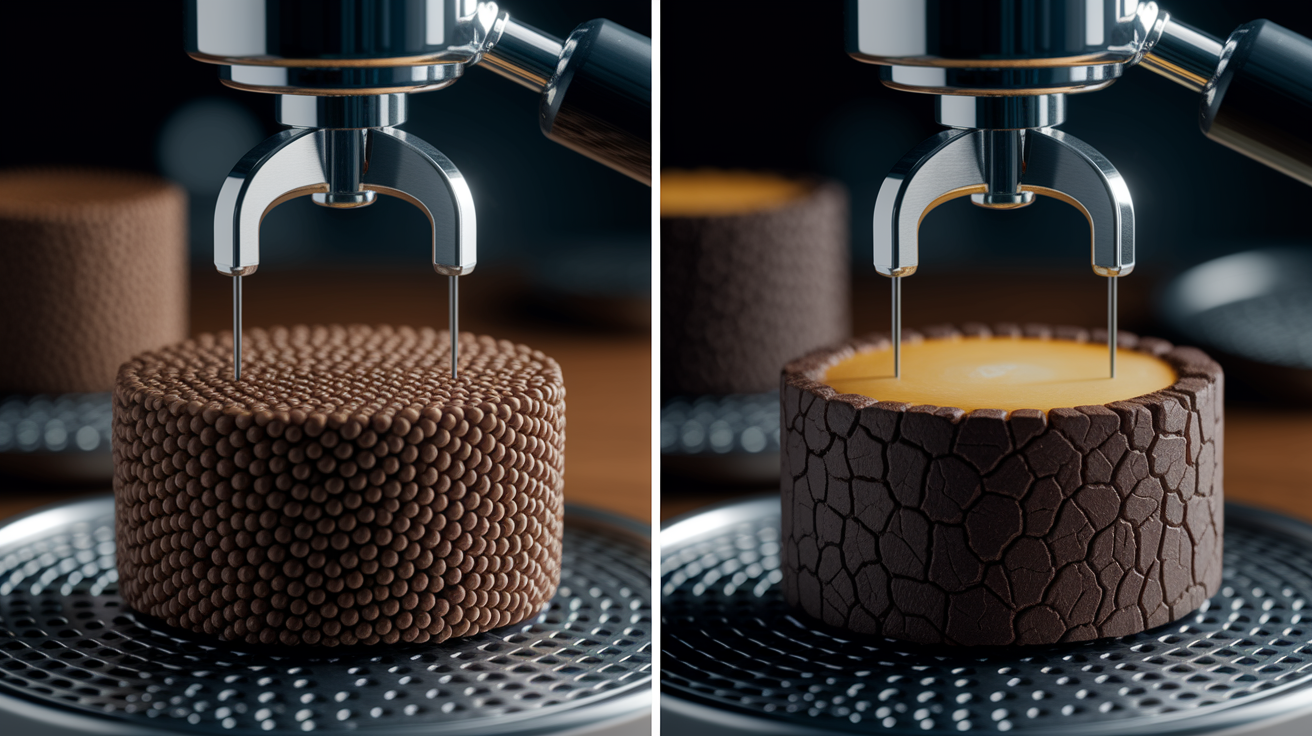
Light roasts are denser because they spend less time roasting. Water doesn’t want to move through those tightly packed cells, so you need deeper, more active redistribution to break clumps and get rid of dry pockets. Dark roasts are more brittle and oily. They fracture easily when you grind them, and the fines they produce stick together. If you’re too aggressive with distribution, you’ll create extra fines or compact those oily zones, which kills flow.
For light roasts, set your adjustable distribution tool to go 2 to 4 mm into the puck surface. Use 3 to 6 full rotations with solid lateral force to move dense particles around and fill voids. Pair that with fine WDT needles, somewhere between 0.3 and 0.5 mm diameter, and do 20 to 40 vertical passes to break up micro-clumps before you distribute. Tamp with 25 to 35 lb of pressure to get the denser bed compact and even. For dark roasts, set your distributor to skim the surface at 0 to 1 mm. Use only 1 to 3 gentle rotations with almost no downward force. Switch to thicker WDT needles, around 0.5 to 1.0 mm, or just use fewer needles. Limit yourself to 6 to 20 passes so you don’t shatter brittle particles. Tamp lightly at 15 to 25 lb to avoid crushing the puck.
Good distribution on a light roast cuts down on channeling and can speed up a slow shot by 2 to 10 seconds, helping you land in the typical 25 to 35 second window. Over-aggressive distribution on dark roasts crushes fragile grounds, creates excess fines, and leads to bitter, ashy flavors or weird stalling during the shot. Under-distributing a light roast leaves voids that cause fast channeling and sour, thin espresso.
Roast-dependent adjustment basics:
- Light roast WDT: Fine needles (0.3 to 0.5 mm), 20 to 40 passes, full depth to the basket floor.
- Dark roast WDT: Thicker needles (0.5 to 1.0 mm) or fewer needles, 6 to 20 passes, minimal lateral sawing.
- Light roast distributor: 2 to 4 mm engagement, 3 to 6 rotations, firmer lateral force.
- Dark roast distributor: 0 to 1 mm engagement (skim), 1 to 3 gentle rotations, minimal downward pressure.
- Tamp pressure: Light roast 25 to 35 lb; dark roast 15 to 25 lb, always level and consistent.
Roast-Driven Puck Behavior and Its Impact on Extraction Stability

Light roast particles lock together tightly because they’re denser, which means dry pockets can form during distribution. If you don’t break those pockets apart, water finds the easiest path and rushes through weak spots, leaving other zones under-extracted. This often adds 5 to 15 seconds to your shot time compared to the same grind and dose with a dark roast, and you’ll taste sour or grassy flavors where extraction didn’t finish.
Dark roast grounds fracture easily during grinding and distribution. They produce more surface oil and fine particles. Those oil-coated fines move around when you agitate the puck too much, creating dense zones that block flow or cause the shot to start fast and then stall unevenly. The oil makes particles stick together, which sounds good but actually raises channeling risk because small cracks in the puck become the preferred path for water. Light distribution keeps the puck intact and avoids concentrating fines into problem areas.
| Roast Type | Structural Traits | Distribution Risks |
|---|---|---|
| Light | Dense, less porous, stronger particle interlock, fewer surface oils | Dry pockets, radial density differences, voids causing fast channeling if under-distributed |
| Dark | Brittle, more porous, high surface oil, fragile particles | Excessive fines from over-agitation, oil-coated clumps, uneven compaction, fissures if tamped too hard |
Grind, Dose, and Basket Strategy When Adjusting Distribution by Roast

When you switch from dark to light roast, grind 1 to 3 clicks finer to boost surface area and slow the flow enough to develop sweetness. When you move from light to dark, coarsen by 1 to 2 clicks to avoid choking the shot with fines and over-extraction. Keep your dose consistent within plus or minus 0.1 to 0.2 g so you can isolate grind and distribution changes without wondering if dose variation caused the shift in extraction time.
Light roasts produce slow flow if you skip thorough distribution, because dense clumps block water from spreading evenly. Dark roasts clog and turn bitter if you over-distribute, because aggressive tool motion breaks brittle particles into extra fines that compact and stretch contact time. Use an 18 to 20 g dose in a double basket as your baseline for both roast types. If your basket’s underfilled, the distributor won’t engage properly. If it’s overfilled, you’ll compress the puck too much before tamping even starts.
Basket size and puck thickness interact with your distribution depth setting. In a smaller single basket (8 to 10 g), reduce distributor engagement by about 1 mm compared to a double basket to avoid crushing the thinner bed. In larger triple baskets, you might need slightly deeper engagement for light roasts to reach the full bed. But keep dark roast distribution shallow no matter what basket size you’re using.
| Basket Type | Dose Range | Distribution Consideration |
|---|---|---|
| Single | 8 to 10 g | Reduce distributor engagement around 1 mm vs double; avoid over-compacting thin bed |
| Double | 18 to 20 g | Standard baseline; light roast 2 to 4 mm depth, dark roast 0 to 1 mm depth |
| Triple | 21 to 24 g | May need plus 1 mm engagement for light roast to reach full bed; keep dark roast shallow |
Extraction-Time and Flavor Outcomes Caused by Distribution Changes

Good distribution for light roasts reduces channeling, evens extraction, and prevents underextraction flavors like sour grass or green apple tartness. Expect shot times in the 25 to 35 second range for a typical double basket. Distribution that eliminates voids can speed flow by 2 to 10 seconds compared to a poorly distributed puck. You’ll get more clarity and body because more of the coffee bed contributes to the final cup instead of just a few fast channels.
For dark roasts, gentler distribution avoids over-extraction of fines and reduces bitter harshness or ashy notes. Overly aggressive distribution or tamping can compact the puck, push extraction past 35 seconds, and pull unpleasant tannins and char flavors. Target yield ratios shift, too. Light roasts often work best at longer ratios like 1:2.5 to 1:3 (for example, 18 g in and 45 to 54 g out) to pull enough sweetness and balance acidity. Dark roasts usually stay closer to 1:2.0 to 1:2.2 to avoid bitterness.
Sensory changes from distribution errors:
- Under-distributed light roast: Sour, thin, grassy espresso with uneven extraction; some zones over-extract through channels while most under-extract.
- Over-distributed dark roast: Bitter, ashy, harsh finish; excess fines compact and stretch contact time, pulling unpleasant tannins.
- Channeling from voids (light roast): Fast gush followed by slow drip; flavor’s sour in the fast portion and can turn bitter in the tail.
- Fines migration (dark roast): Shot starts fast, stalls mid-pull, and finishes slow; taste is uneven with bitter spikes and thin body.
- Correct distribution match: Clean acidity and sweetness in light roast (apple, berry, floral); smooth chocolate or caramel in dark roast with minimal astringency.
Troubleshooting Distribution for Light and Dark Roasts
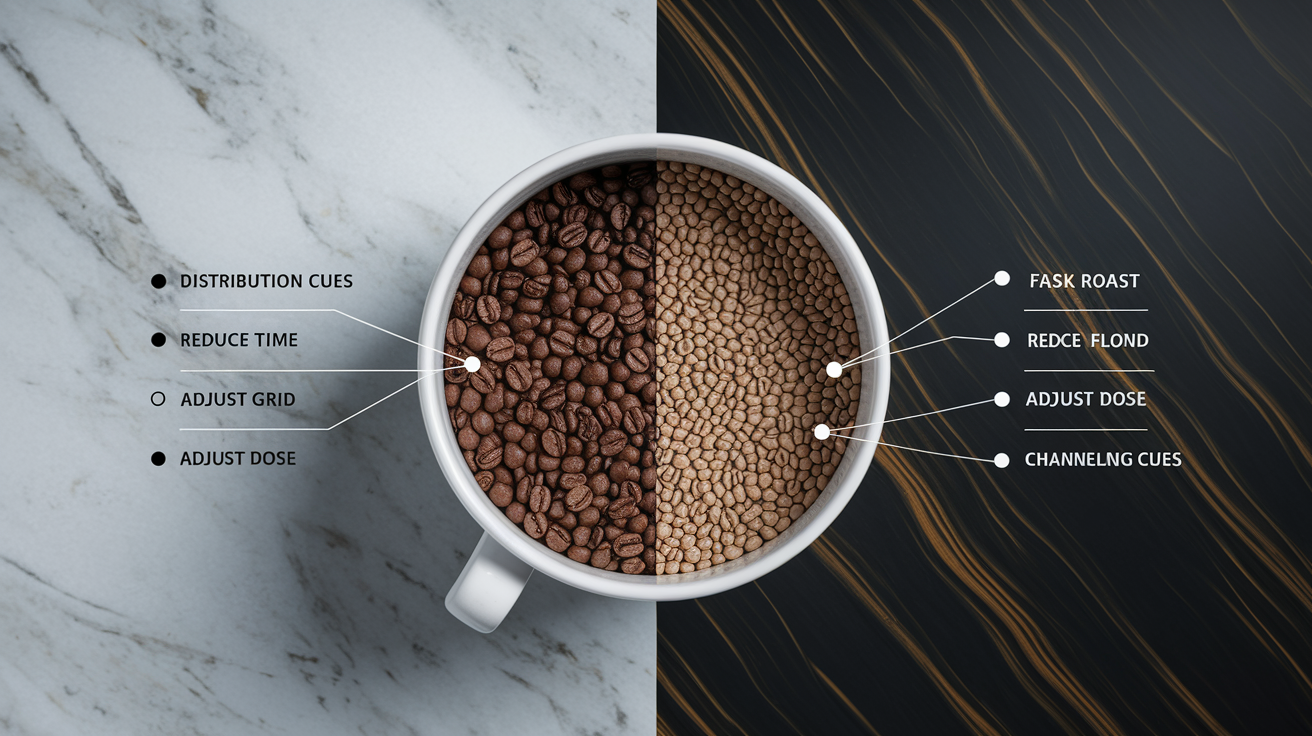
Fast flow combined with channeling in a dark roast shot (finishing under 15 seconds) usually means an uneven puck or large voids. The fix is gentler reflow with your distribution tool, reducing tamp force from 25 lb down to 15 to 20 lb, or bumping dose by 0.5 to 1.0 g to fill the basket more completely. If you see brittle particle fragmentation (fine dust coating the basket rim), switch to fewer WDT passes and a shallower distributor setting to stop shattering the grounds.
A choked light roast shot that runs longer than 40 seconds after you improve distribution means the puck’s too dense or over-compacted. Coarsen your grind by 1 to 3 clicks or reduce tamp pressure from 30 to 35 lb down to 20 to 25 lb. If the espresso tastes bitter and harsh after aggressive redistribution of a dark roast, you’ve over-extracted fines. Reduce distribution depth, lighten your tamp, or increase grind size by 1 to 2 clicks to open flow and shorten contact time.
| Symptom | Likely Cause | Fix |
|---|---|---|
| Fast flow + channeling, dark roast (<15 s) | Uneven puck, large voids, brittle particle fragmentation | Gentler reflow, reduce tamp to 15 to 20 lb, increase dose plus 0.5 to 1.0 g, fewer WDT passes |
| Choked shot, light roast (>40 s) | Over-compacted puck, grind too fine, tamp too firm | Coarsen grind 1 to 3 clicks, reduce tamp to 20 to 25 lb, check distributor isn’t crushing bed |
| Bitter, harsh espresso after redistribution, dark roast | Over-extraction of fines, excessive distribution depth or rotations | Reduce distributor depth to 0 to 1 mm, lighten tamp, coarsen grind 1 to 2 clicks, limit WDT passes |
Final Words
Dial distribution by roast: light roasts need deeper, active redistribution and a firmer tamp. Dark roasts need shallow, gentle distribution and lighter tamp. Change one variable at a time.
Use exact metrics as your starting point: light 2–4 mm depth, 3–6 rotations, WDT 0.3–0.5 mm with 20–40 passes, tamp 25–35 lb. Dark 0–1 mm, 1–3 rotations, WDT 0.5–1.0 mm with 6–20 passes, tamp 15–25 lb. These moves help avoid fast channeling or choked shots.
Apply these distribution tool adjustments for dark roast vs light roast espresso, taste, and refine. You’ll get steadier shots and less waste.
FAQ
Q: Should dark roast be finer or coarser for espresso?
A: Dark roast should be slightly coarser for espresso because dark beans are brittle and extract faster; start 1–2 clicks coarser than your light-roast baseline, use gentler distribution and lighter tamp (15–25 lb).
Q: What is the 15-15-15 coffee rule?
A: The 15-15-15 coffee rule is a simple starting heuristic: 15 grams coffee, 15 seconds bloom or prewet, then 15 seconds main pour or pause. Use it to build a repeatable baseline, then tweak by taste.
Q: Is lighter or darker roast better for espresso and what are best settings for light roast espresso?
A: Lighter roasts are often preferred for clarity and acidity in espresso, but they need finer grind (1–3 clicks finer), deeper distributor engagement (2–4 mm), more WDT passes (20–40), and firmer tamp (25–35 lb).